Trans Voice Training in Multiple Languages (Without Giving Up)
Jan 29, 2026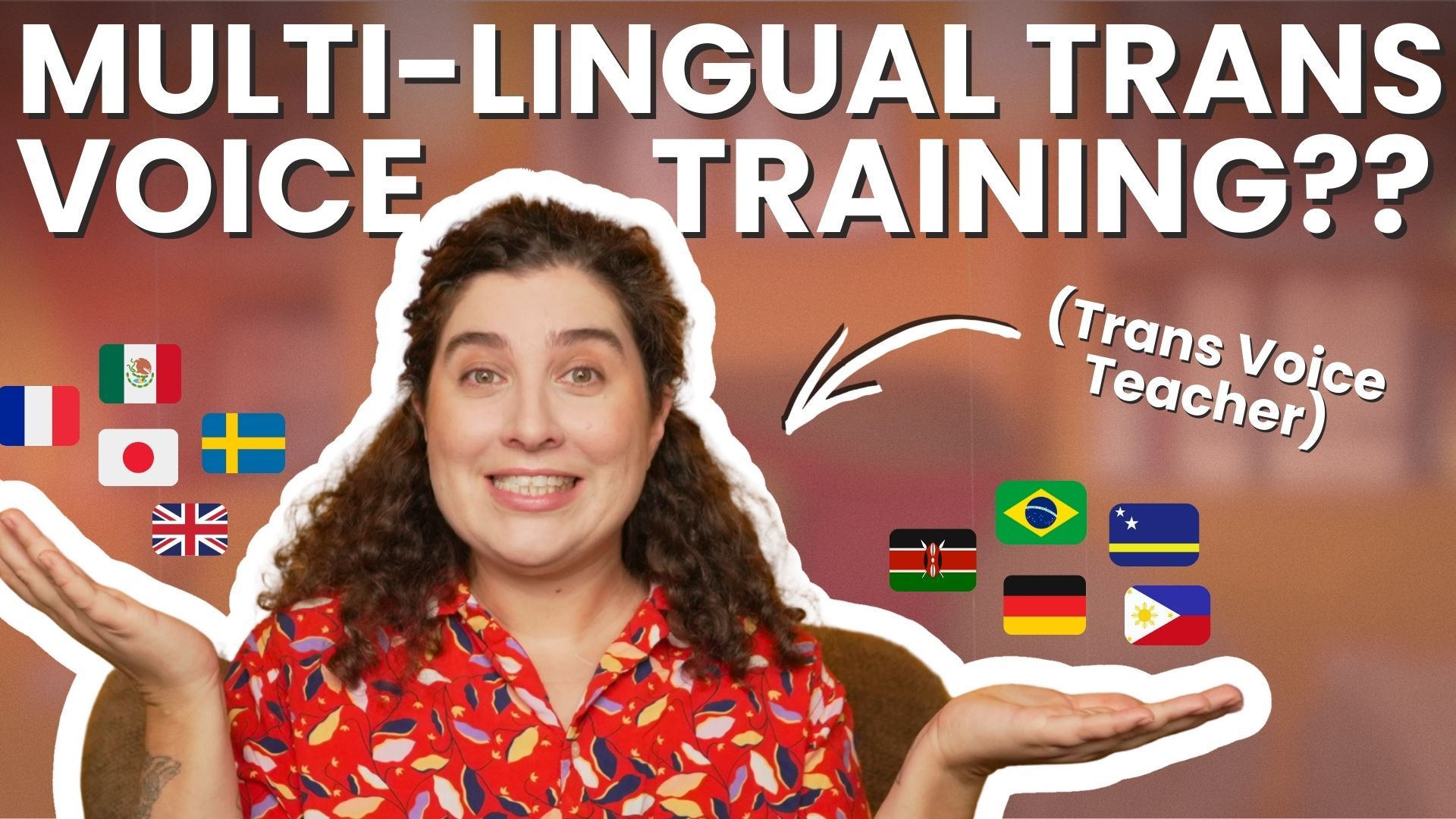
Have you ever noticed that your voice sounds different when you switch languages? Maybe you're higher in Spanish, deeper in English, or your whole vibe shifts when you code-switch.
And now you're thinking: "Wait, if I'm training a new voice for gender affirmation, do I have to do this... twice? Three times? In every language I speak?"
The short answer? Yes. But that's not the whole story!
As a gender-affirming voice teacher, I'm here to reframe this not as a limitation, but as proof that you already have superpowers. If you're bilingual or multilingual, you're already doing something that many monolingual people struggle to believe is even possible: you're changing your voice, on command, every single day.
Let's talk about what that means for your trans voice training, why it happens, and how you can use it to your advantage.
Watch the Full Video
Prefer to read? Keep scrolling for a complete breakdown of trans voice training for multilingual and bilingual speakers.
The Challenge (But Not Really)
Each language you speak has its own motor memory when it comes to phonation. The way you hold your tongue, the pitch patterns you use, the rhythm and flow of speech—it's all slightly different depending on the language.
And it's not just about the mechanics of speech. Each language exists in a cultural context, and each culture has its own norms and expectations around gender and voice.
What sounds feminine in English might not sound feminine in Mandarin. What feels masculine in Spanish might read differently in French. The codes are different. The rules are different. The vibes are different.
So when you switch languages, you're not just switching accents—you're stepping into a whole different set of vocal and cultural patterns.
But before you panic and think, "Oh great, now I have twice as much work to do," let me tell you why this is actually amazing.
You're Already a Voice Chameleon
Here's the thing that blew my mind when I first learned it: bilingual speakers naturally change their pitch and vocal quality depending on which language they're speaking.
A 2017 study on bilingual speakers found that people's fundamental frequency—their average pitch—shifts depending on the language they're using.
As someone who lives in Montreal—one of the most multilingual cities in the world—I see this every day.
People use certain vocal qualities when they speak one language, and they easily shift their vocal characteristics when they switch to another.
If you are multilingual, you're likely doing this right now without even thinking about it!
Your Multilingualism Is an Advantage for Voice Training
So here's the reframe: if you can code-switch between languages, you can code-switch between voices.
If you're multilingual, you might even be better positioned to learn new ways of using your voice because you already have practice with vocal flexibility.
And if you're monolingual, don't worry—this doesn't make your starting point any harder than it was five minutes ago. Just take this as proof that if their voice is that flexible and changeable, yours can be too.
Learning a New Language? You Have Even More Advantages
If you're currently learning a language, you have even more advantages for trans voice training. The skills you're using—like reading aloud, identifying your weaknesses, diversifying your practice, embracing mistakes, and immersing yourself in the language—are the exact same skills that make voice feminization training and voice masculinization training successful.
Plus, learning to hear subtle differences between sounds in a new language also helps train your ear to hear differences in your transgender voice training as well. You're already halfway there!
How to Approach Multilingual Voice Training
Okay, so how do you actually do this? How do you train a voice that works across multiple languages?
Here's my approach:
1. Start with One Language
Pick the language you use most often, or the one you feel most comfortable practicing in, and start there. Build your foundation. Concentrate on getting confident with the vocal characteristics you're working on—like pitch, resonance, weight, and inflection.
Once you have a solid grasp of the basics and of your target voice in that first language, then you can start bringing it into your other languages.
2. Make Lists of Common Daily Phrases for Each Language
You likely use your different languages in different contexts. I have students here in Montreal who speak English in their relationship, French at work, and Spanish with family. Each of those contexts will have different common phrases that are used.
Make a list for each language and practice saying your common phrases in your target voice.
3. Notice the Cultural Codes in Each Language
Spend some time observing how gender is expressed vocally in each of your languages and cultural contexts. Listen to people around you, watch videos, or listen to podcasts in each of your cultural contexts.
Ask yourself: What does a feminine or masculine voice sound like in this language or context?
And then ask: Do I want to follow those codes, or do I want to intentionally break them?
There's no right answer. It's your voice. You get to decide.
4. Build Separate Motor Memory for Each Language
Just like you have different motor memory for pronouncing words in different languages, you'll need to build different motor memory for your target voice in each language.
That means practicing in each language regularly. It doesn't have to be equal amounts of time—focus on the languages you use most.
5. Use Your Warm-Up as a Multilingual Practice Space
If you're doing a daily vocal warm-up (and you should be!), try working your languages into it by running through your exercises in different languages.
Slide your pitch while counting in Portuguese. Do a resonance exercise while saying German vowels. Practice your vocal weight on a phrase you use all the time in Swahili.
This keeps all your languages active in your voice training, even if you're focusing most of your energy on one at a time.

Follow-Along Voice Warm-Up for Every Trans Voice Practitioner
Common Questions and Concerns About Multilingual Trans Voice Training
Now that we've covered how to build your multilingual voice training practice, let's troubleshoot some common issues:
"My Target Voice Works in English But Falls Apart in My Other Language"
This is normal! You've practiced more in English, and maybe you've spent more time listening to English examples. The solution is just... more practice in the other language. Be patient with yourself. You're learning a new skill in a new context.
"I'm Learning from English-Language Resources. Will These Exercises Even Work for My Language?"
Great question! The underlying mechanics of voice production are universal. Your vocal folds, your larynx, your vocal tract—they work the same way whether you're speaking English, Japanese, Arabic, or Papiamentu.
So yes, exercises for pitch, resonance, and vocal weight will absolutely work across languages because they're targeting the physical mechanisms of your voice, not the language itself.
However—and this is important—how you apply those skills will vary depending on your language and cultural context.
For example, the pitch range that reads as feminine in English might be different from what reads as feminine in Japanese. The resonance that feels right in Yoruba might need adjustment in Tagalog. And in all cases, remember this is not just one target but a range of possibilities.
So while you can absolutely use English-language resources to learn the fundamental skills, you'll need to do your own research and observation to figure out how to apply those skills in your specific language and cultural context.
That's actually why I emphasize the research phase so much in my courses! I want to give you the tools to figure out what works for your voice in your context, not just copying what works for English speakers.
"I Feel Like I'm Performing a Stereotype When I Try to Sound Masculine/Feminine in Another Language"
That's fair. Gender stereotypes exist in every language, and you don't have to follow them. Use the cultural codes as a starting point for research, but ultimately, your voice is yours.
And remember: knowing the borders of these codes actually better equips you to break them when you want to. If you want to break the mould, break it.
"It's Easier to Use My Target Voice in One Language Than the Other"
That makes sense! Some languages might align more naturally with your target voice characteristics. For example, if you're working on raising your pitch and you speak a language with naturally higher average pitches, that language might feel easier.
Use that to your advantage. Start where it's easier, build confidence, then bring those skills into the more challenging language.
"I Keep Accidentally Slipping into My Old Voice When I Switch Languages"
You're basically training yourself to override years of automatic code-switching patterns. It takes time. This is true of so many things outside of voice as well—like driving a rental car with different features or using a different computer operating system at work. The skills are transferable, but they take time to engrain.
Use reminders—like a bracelet or ring—to help you stay conscious of your voice when you switch languages.
"My Family/Community Only Knows My Old Voice in Our Shared Language, and I'm Nervous About Changing It"
This is real. These are huge questions around identity, belonging, and community. If you're worried about how your voice change will be received in a specific cultural or family context, take it slow. You don't have to change everything at once.
And remember, you can always have multiple voices for different contexts if that feels safer or more authentic to you.
You can also share this video with your family, where I explain what voice training is and how it works, in case you don't have the words.

Someone You Love Is Voice Training – Here’s What You Need to Know
The Silver Lining
Let me say this one more time, because it's important:
If you're bilingual or multilingual, you already know—in your bones—that your voice is not fixed. You've been shifting your vocal patterns your whole life, so you're not starting from scratch. You're building on skills you already have. And that means you have a huge advantage.
Conclusion: Your Multilingual Voice Is a Superpower
So yes, you'll need to practice your target voice in all the languages you speak regularly. But try not to think of it as a burden. It's an opportunity to explore the full range of what your voice can do.
Your multilingualism isn't a complication. It's a superpower.
Ready to explore how voice training can work for you? Sign up for my free one-hour webinar, Change the Gender of Your Voice: No Hormones or Surgeries Required, and work with a transgender voice coach who understands your journey.
Change The Gender of Your Voice (No Hormones or Surgery Required!)
Ready to transform your voice into one that truly reflects YOU? Join an upcoming FREE masterclass to discover straightforward, effective strategies for crafting a gender of your voice that brings you confidence and happiness—no hormones or surgeries required!
Sign up now and receive free bonuses only available in the webinar!
Resources for Multilingual Trans Voice Training
If you want more support with voice training across languages, my courses—Mindful Voice Feminization, Masculinize Your Voice Without Testosterone, and Mix & Match: Designing Your Nonbinary Voice—all include lessons on cultural context and how to adapt exercises to your specific needs, whatever languages you speak.
Check out my freebies library for more voice training resources to support your journey.

Mindful Voice Feminization
Mix & Match! Designing Your Nonbinary Voice

Masculinize Your Voice Without Testosterone
Let me know in the video comments above: How many languages do you speak, and have you noticed your voice changing between them? I'd love to hear about how your languages interact with your voice!
Want weekly tips, resources, and insights on trans voice training? Sign up for my newsletter and get the latest content delivered straight to your inbox. It's free!