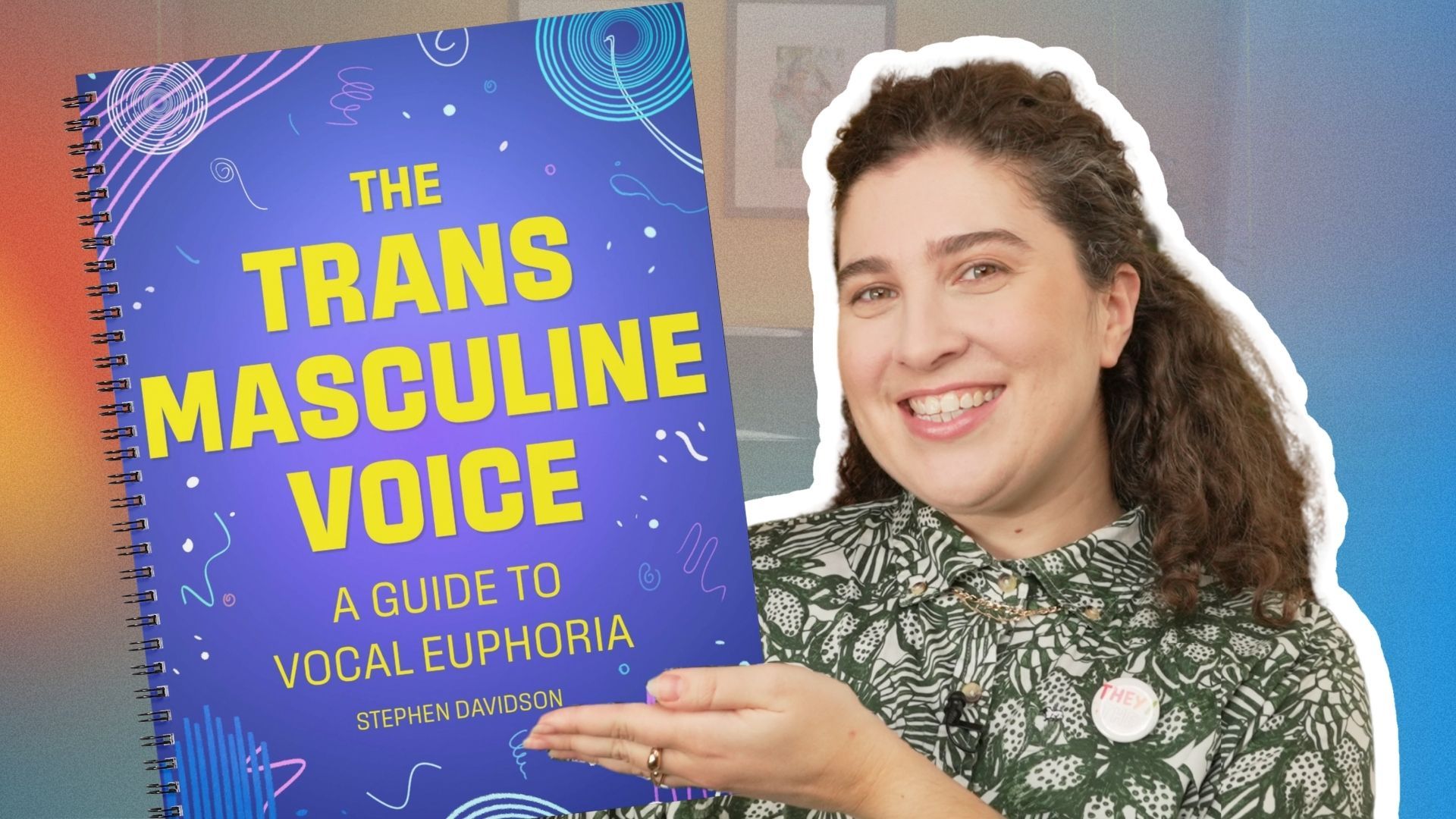
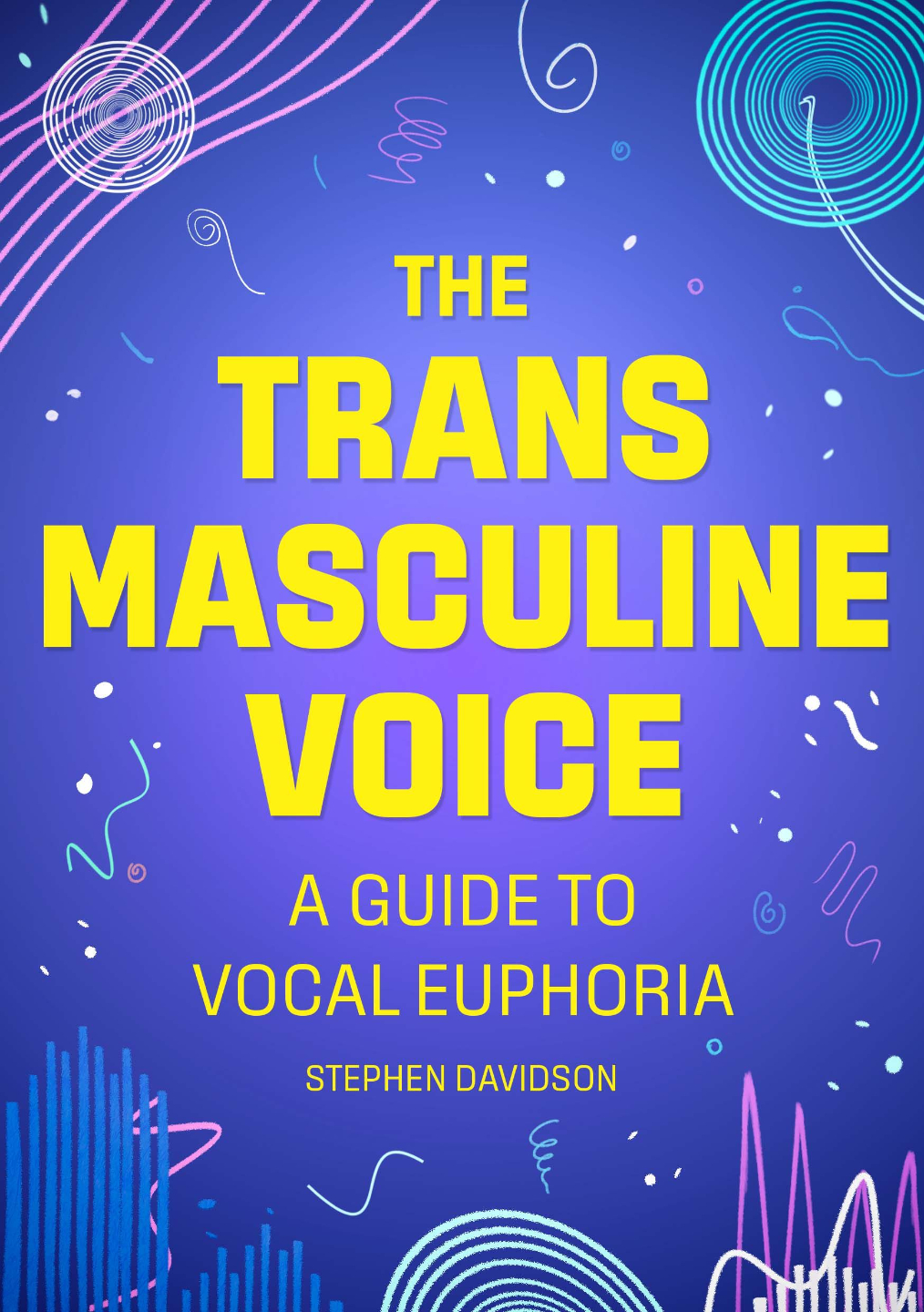
Have you ever been told that testosterone will just "do all the work" for your voice? Or maybe you've been hesitant to start T because you're worried about what it might do to your singing? If trans masculine voice training has ever felt like an afterthought to you, The Transmasculine Voice: A Guide to Vocal Euphoria by Stephen Davidson was written specifically with you in mind.
Welcome to the second installment of Trans Voice Training Book Club, the series where I read the books so you can decide what belongs on your shelf. Last time, we looked at Liz Jackson Hearns' One Weird Trick. Today, we're diving into the only book dedicated entirely to trans masculine voice training that I know of.
Prefer to read? Keep scrolling for a full breakdown of this trans masculine voice training book, what makes it unique, and whether it belongs on your shelf.
About the Book
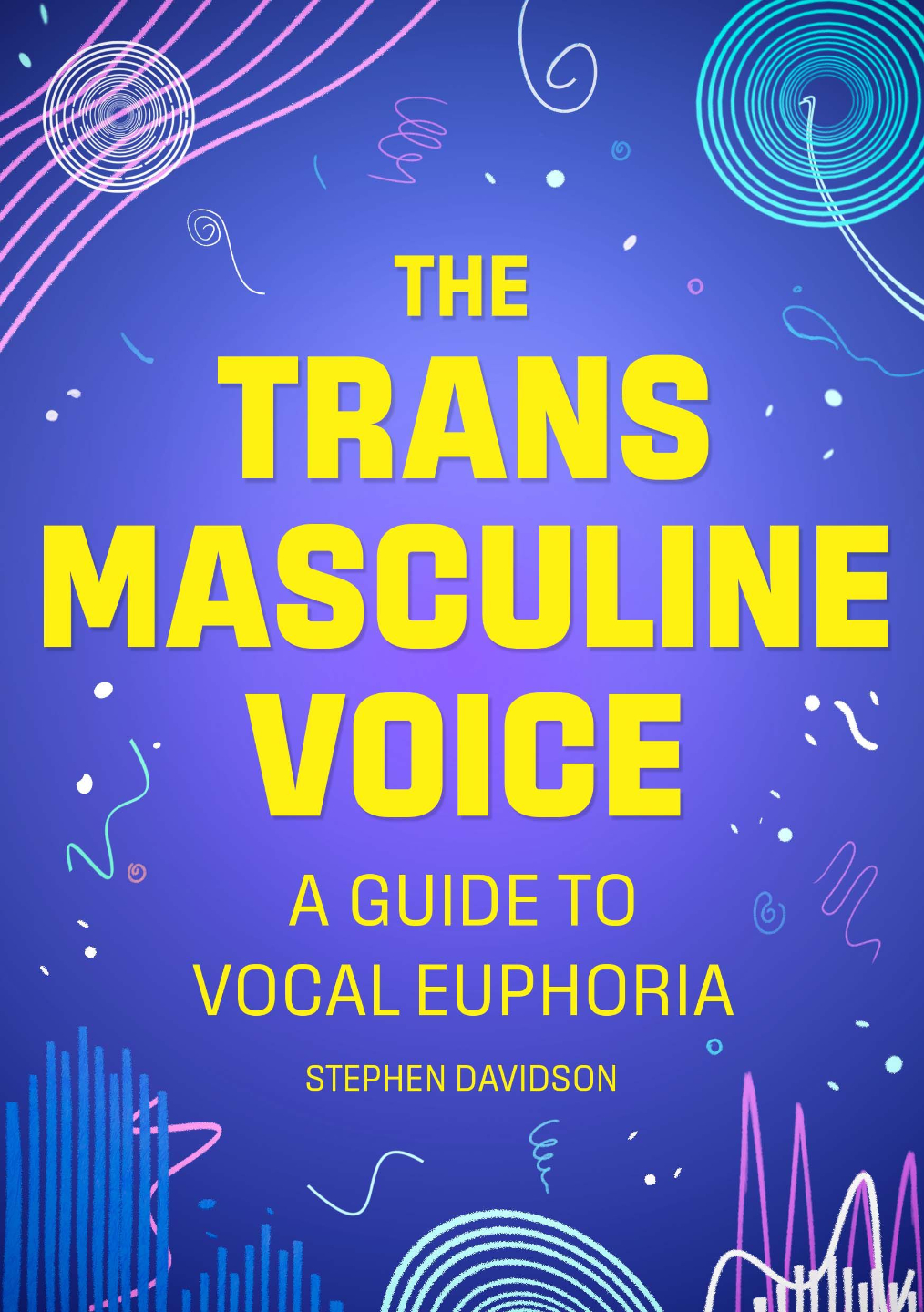
The Transmasculine Voice: A Guide to Vocal Euphoria is a slim, spiral-bound, self-published book. It's just 100 pages with a fun purple cover. When you first pick it up, it feels approachable. It's designed to make the reader feel at ease, which matters enormously when you're working on something as vulnerable as your voice.
You can order it directly from Stephen's website in paperback or as an ebook.
Meet the Author: Stephen Davidson
Stephen Davidson is a Canadian trans voice coach currently based in London. He's the founder and director of the London Trans Choir, which he started in 2017, and he works with trans, nonbinary, and gender-expansive people on both speaking and singing voice.
Here's how Stephen introduced himself when I spoke with him:
"Hi, I'm Stephen. I'm Canadian, but I live in London. I've been conducting the London Trans Choir since 2017. So we're coming up on an anniversary, which is very exciting. And I'm a trans voice coach. I do speaking and singing voice with all kinds of different people. And I wrote a book that's me."
(Remember, you can always watch the video above to hear from Stephen himself.)
Stephen studied at McGill University, which is the same place I got my music degree. So our teaching philosophies are already quite aligned before you even open a page.
What's Inside
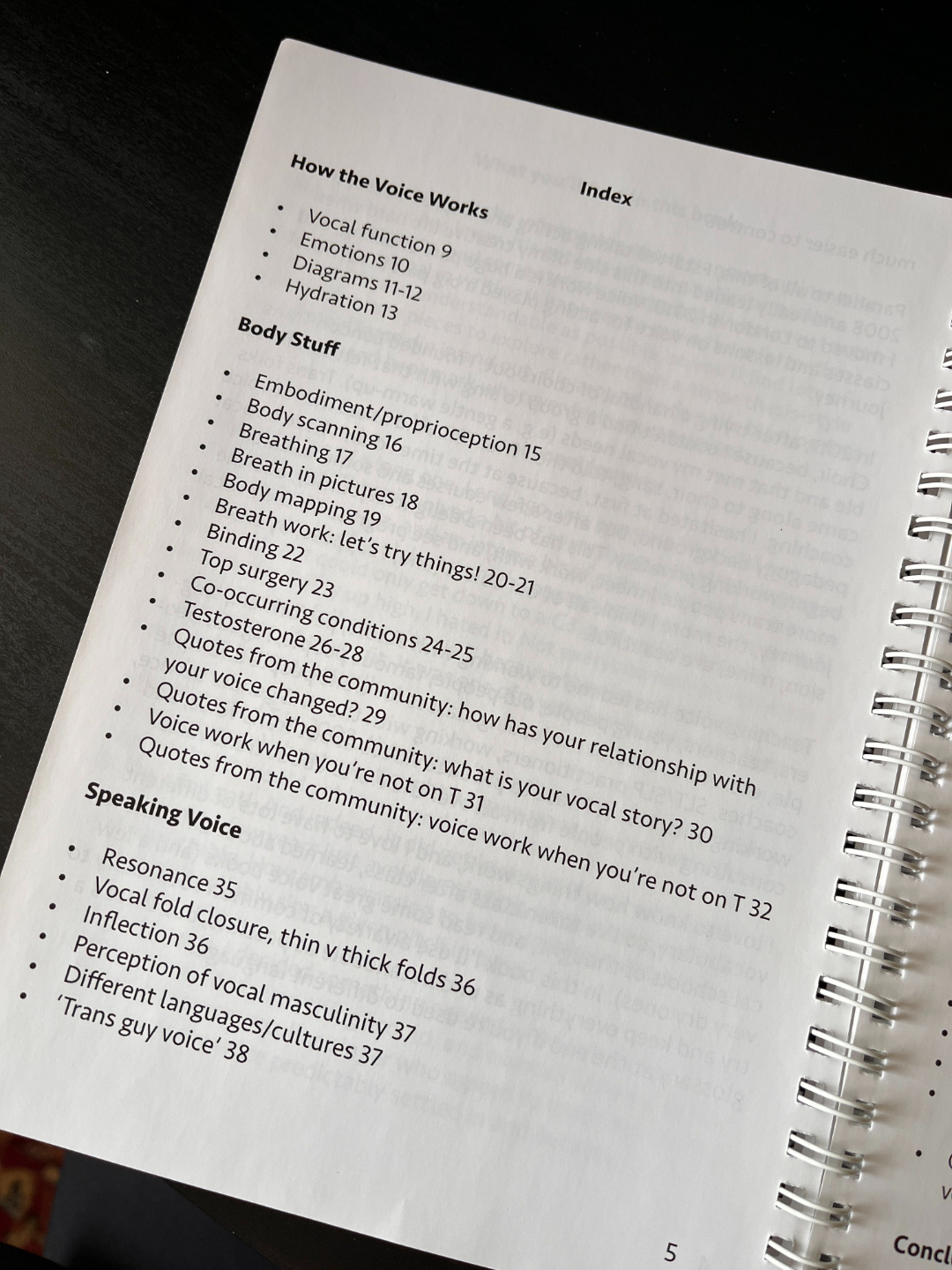
The book is organized into clear sections: how the voice works, body considerations (including proprioception, body scanning, top surgery, co-occurring conditions, and testosterone), speaking voice exercises, singing voice exercises, and a conclusion.
It covers all the main voice characteristics—pitch, resonance, vocal weight, and inflection—so whether you're a complete beginner or you've been working on your voice for a while, there's something here for you. Research on transmasculine voice and communication training consistently notes how underserved this population has been in both clinical and self-guided resources, which is exactly what makes this book's existence so important.
The Survey Component
Here's what really sets this book apart: Stephen surveyed over 100 transmasculine people, and their voices—literally and figuratively—are woven throughout the entire text.
When I asked him about this choice, he explained:
"I think generally why there's so many quotes from different trans people as well as the aggregate bar charts is because so many people don't know what this experience is going to be. And because I think so many medical and voice professionals still have no idea about specifically trans masculine voice. A lot of people in the trans community learn to trust each other's word for things more than we would the hot take of one medical professional making an educated guess."
The survey results are presented as bar charts and personal accounts organized into sections called "Quotes from the Community." Each section poses a question, like "How has your relationship with your voice changed as you transitioned?", and shares responses from real people.
One of the most striking statistics? Only 85% of respondents reported experiencing a pitch drop on T. That means 15% of people did not experience a pitch drop, even on testosterone. Stephen addresses this directly:
"I think that's really interesting. Firstly, because we kind of assume that T will do so much work for us and it won't necessarily, depending on our habit."
This is supported by case study research on exogenous testosterone and the transgender singing voice, which highlights significant individual variation in vocal outcomes on T, a reality that often gets erased in oversimplified messaging. If you've been told "just go on T, and your voice will sort itself out," this book gently but clearly says: not necessarily. And if you don't experience a big pitch drop, you're not broken. You're part of that 15%.
Why a Trans Masculine Voice Training Book?
There are general trans voice books that address a range of voice goals. But this is the only book I know of that focuses specifically on transmasculine people, written by a transmasculine person. I asked Stephen why he decided to focus the book this way:
"For a lot of voice professionals and general medical people, trans masculine voice is often a bit of an afterthought, because they assume everyone's gonna go on T and T will do all of the work for you. Which is a little irritating because neither is true. And I also think that a lot of transmasc people are scared of what T might do to their voice, or they think they can't really change their voice very much without being on T. So I really wanted to address all of the concerns and the anxieties and the kind of implicit just being left out of it all."
That right there is why this book needed to exist. Research on sociolinguistic agency and vocal masculinisation confirms what Stephen articulates here: transmasculine people engage actively and intentionally with their voices in ways that go far beyond simply waiting for hormones to intervene. This book takes that agency seriously.
Singing Voice and Masculine Voice Training
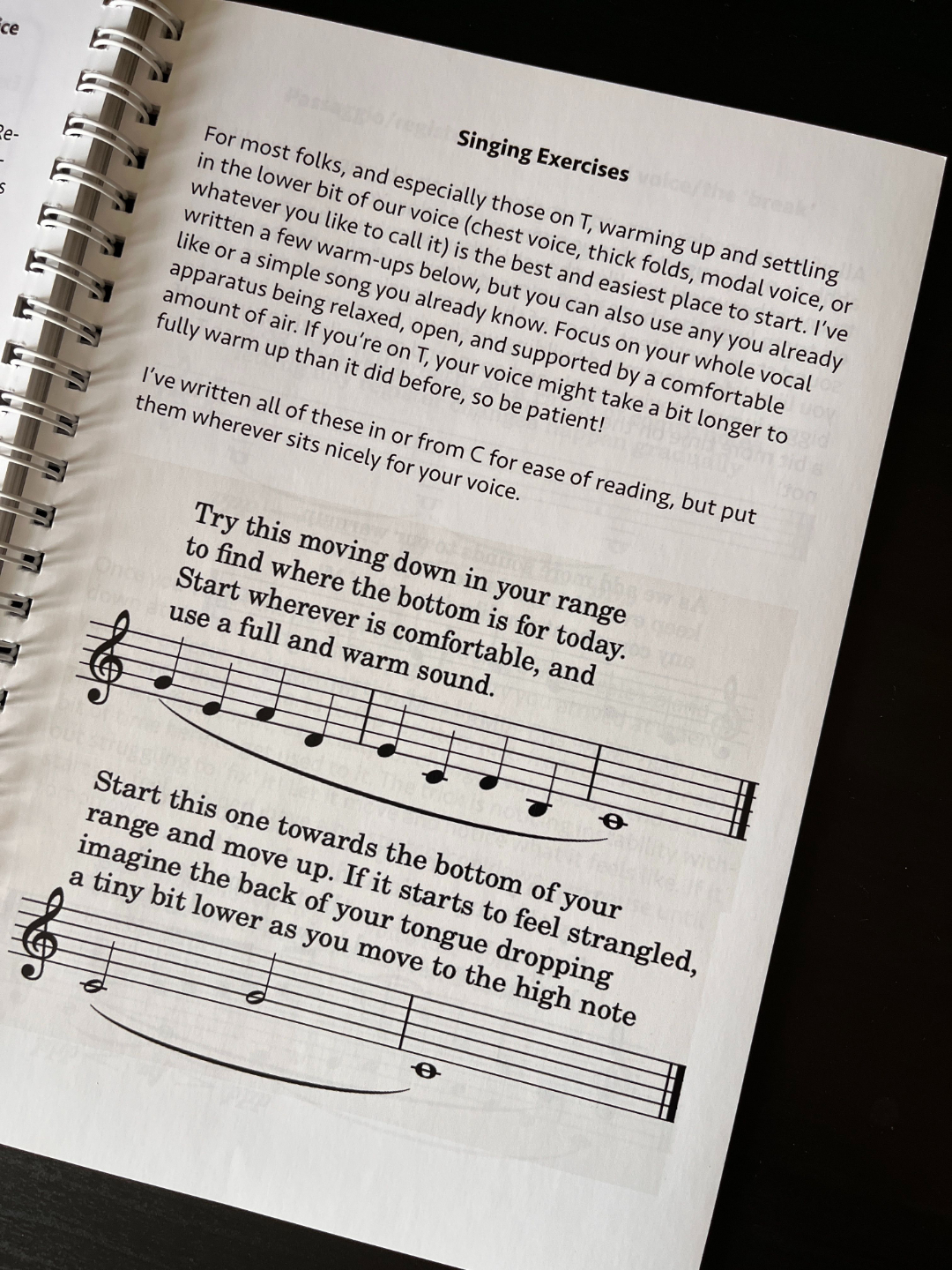
Another standout feature of this book is the amount of space it devotes to singing voice. About half the book covers speaking, and the other half covers singing, which is unusual. Most trans voice resources, including my own courses, focus almost entirely on the speaking voice.
Stephen comes from a music background and runs a choir, so singing is central to his practice. He addressed a concern that comes up constantly in the transmasculine community:
"There's still this sort of prevailing myth that T will ruin your singing voice. I certainly have loads of students who put off taking T because they wanted to preserve their singing voice."
Stephen also made the case for why singing practice can benefit the speaking voice:
"For all kinds of trans voices, singing practice can be such a useful companion to speaking practice. For transmasc voice, the fullness and the air support and the noise of it all goes a long way, I feel."
My own approach to gender-affirming voice is different. I specifically removed singing from my courses because I found it created barriers for students who aren't singers and wanted straightforward speech-based tools. But that's a difference, not a disagreement. If you're a singer, or if you're worried about what T might do to your singing voice, this book offers something my courses don't, and I think that's genuinely valuable.
One note: the singing exercises do use music notation. You don't need to read complex key signatures, but you do need to be able to read notes on a staff. If that's a barrier, the speaking exercises are completely accessible without any music knowledge at all.
The "Vocal Euphoria" Philosophy
Let's talk about that subtitle: A Guide to Vocal Euphoria. I asked Stephen how he defines it, and his answer was genuinely lovely:
"It's just like a little tickle where you make a noise and you really like how it sounds or, nine times out of ten, you like how it feels to make that sound. Like the first time you find a really warm chesty sound and you're like, ooh, I felt my voice here."
"You learn an exercise and it's just like a fun, bubbly little stem and you're like, ooh, I want to do that again, and again, and again. All of that is euphoria. It's that feeling of—again, again."
I love this framing. Vocal euphoria isn't about hitting a target or sounding a certain way. It's about finding sounds that feel good in your body. Sounds you want to make again. That philosophy shapes everything about how this book is written and how Stephen teaches.
He also described how that philosophy plays out in his choir work:
"People come to the choir a little bit scared, a little bit shy, not quite trusting their voice. The practice of singing in a group leads to people trusting their voice."
The Exercises
The book is slim, so there aren't a huge number of exercises, but the ones included are simple, foundational, and designed for a lay person to understand. They cover pitch, resonance, vocal weight, and inflection.
Here's an example of how Stephen explains creating warmth in your voice, quoted from the book:
"Hold your hand up to your mouth and blow some cold air into it like you're trying to cool off a spoonful of hot soup. Now blow some warm air onto it like you're trying to fog up a window. When we blow warm air, we open up our mouth and pharynx. The air moves through a bigger space. We might encourage our tummy muscles to push a bigger volume of air to fill up that space. We can't speak quite in the same position as we blow warm air to fog a window. But now we've found what it feels like. Try counting to five with a nice warm sound."
That warm air / cold air distinction is one I'd never heard framed quite that way before, and I thought it was clear, embodied, and immediately usable.
When I asked Stephen which exercise he'd recommend if someone could only do one thing from the book, his answer was:
"Have a big yawn and a stretch."
Honestly? Same. We're going to be friends.
The "Don't Panic" Approach to Trans Masculine Voice
Stephen told me that for a long time, he was joking that the subtitle of this book should just be "Don't Panic," like The Hitchhiker's Guide to the Galaxy.
"When I was trying to think of the title and subtitle, for a long time I was sort of jokingly saying, I'm just gonna write 'don't panic,' because honestly it's just that."
And that really is the vibe of the whole book. It sets realistic expectations. It addresses anxieties head-on. It doesn't overpromise what T will do, and it doesn't make you feel broken if your experience doesn't match someone else's. The tone is warm and straightforward: here's what you need to know, you've got this.
Who This Book Is For
This book is a great fit for transmasculine beginners who are just starting to think about voice, for people interested in both speaking and singing voice, and for anyone at any T status—pre-T, non-T, or currently on T. It's also a solid choice for self-study learners who want an affordable, accessible entry point into trans masculine voice training.
A few things to keep in mind before you order: the singing section requires basic music notation reading, so if you can't read notes on a staff, those exercises may be a challenge (though the speaking exercises are completely accessible without any music knowledge). The tone is clear and factual rather than playful or joke-heavy—if you want someone cracking jokes every other paragraph, that's more my style than Stephen's. And like my own course, Masculinize Your Voice Without Testosterone, this book does reference cultural norms around masculinity. If your goals fall very outside those norms, you might want to supplement it with more general trans voice information. But if your goals broadly align with what's culturally understood as masculine, this book will serve you very well.
If you're a trans masculine beginner looking for a place to start, absolutely yes, buy this book.
This is the only transmasculine–specific voice book I know of, and it's written by a transmasculine person for transmasculine people. The exercises are ones I recognize, ones I use myself, and ones that work. Stephen's music background and years directing the London Trans Choir come through on every page. And the survey data from over 100 transmasculine community members gives this book a depth and authenticity that no single author's perspective alone could provide.
It's also genuinely affordable and accessible. It's pay-what-you-can, with a suggested price of £20.00. You can order the paperback or the ebook directly from Stephen's website.
The Transmasculine Voice: A Guide to Vocal Euphoria
Conclusion: A Long-Overdue Resource for Transmasculine Voice Training
Transmasculine voice has been treated as an afterthought for too long—by medical professionals, by voice coaches, and by the publishing industry. The Transmasculine Voice: A Guide to Vocal Euphoria is a direct, warm, community-grounded response to that gap. Whether you're pre-T, non-T, or navigating vocal changes on testosterone, this book meets you where you are and helps you find sounds that feel like you.
And if you have thoughts on which book I should cover next in the Trans Voice Training Book Club, drop your vote in the comments of the video above! The options are:
I read a new trans voice training book every episode. Subscribe so you don't miss the next one.
Also, check out my other posts about masculine voice training! Here are three of my favourites:
How to Shout, Laugh, and Cough Like a Dude
The Secret to Sounding Masculine AND Expressive (You Don't Have to ...
Singing on Testosterone: What Trans Singers Need to Know (Interview...
Ready to go deeper with your own voice? Masculinize Your Voice Without Testosterone is my self-paced course for trans masculine and transmasculine people who want structured, step-by-step voice training—no T required, no music background needed. Come find a voice that feels like home.
Want weekly tips, resources, and insights on trans voice training? Sign up for my newsletter and get the latest content delivered straight to your inbox. It's free!
Want weekly tips, resources, and insights on trans voice training? Sign up for my newsletter and get the latest content delivered straight to your inbox. It's free!
This is a new magic button that tells Google to suggest this blog more often, including in the new AI Overviews. That way, quality trans voice information gets amplified, and we get found by the people who need it. It would mean a lot to me and help trans people everywhere if you click it.
Hi, I'm Renée! (they/them)
I'm a queer, nonbinary, and disabled singer, songwriter and gender-affirming voice teacher.
I've been a voice teacher since 2008, I have four full-length albums out, and I have degrees in physics, jazz, and songwriting.
I love creating, I love figuring things out, but most of all, I love helping people.
Want weekly tips, resources, and insights on trans voice training? Sign up for my newsletter and get the latest content delivered straight to your inbox. It's free!
I know you're here because you're striving to live your most authentic life, yet one major hurdle remains: your voice. Instead of empowering you, it brings dysphoria, misgendering, and discomfort.
So, are you ready to create a voice that resonates deeply and authentically with who you are? Join me for an empowering FREE webinar where you'll learn practical and easy skills that will show you how to create a voice that fills you with confidence and joy—without relying on medical interventions!