You've been working on your voice. You can hit it when you're focused. But the moment you're ordering coffee, answering a question mid-thought, or telling a story to a friend, it's gone.
If that sounds familiar, you're not doing anything wrong. Real life is full of distractions, and your voice training practice probably isn't. That gap is exactly what this post (and the video below) is designed to close.
In this trans voice training session, we're going to play three games together—Animal Alphabet, the Stroop Test, and Lucky Sevens—using a technique called cognitive load training to help your target voice run on autopilot. Let's go.
Watch the Full Video
Prefer to read? Keep scrolling for a full breakdown of all three games, plus tips for getting the most out of each one.
Why Games? The Science Behind Cognitive Load Training
When you're practicing voice in a focused session, your brain can dedicate most of its attention to one thing: the voice. But in real conversations, your brain is juggling a lot like listening, responding, deciding what to say next, and reading social cues.
That's where cognitive load training comes in.
Cognitive load training means practicing your voice while your brain is engaged in another task. When your attention is split, your brain can't micromanage every detail of your voice, which means your voice has to start running automatically. And that's exactly where you want it to be.
Games are a perfect vehicle for this. They create just enough mental effort to distract you without completely overwhelming you. The goal isn't to be good at the game. The goal is to hold your target voice while your brain does something else.
This kind of practice is one of the most effective ways to build the muscle memory that makes your voice feel natural in the moments that actually matter.
Before You Start: Two Things to Know
Pick One Thing to Focus On
Before you begin, choose one voice characteristic to monitor: pitch, resonance, vocal weight, or contour. Trying to track everything at once will freeze you up, and that's not the point.
Pick the quality you're currently working on and let that be your anchor throughout all three games.
Not sure which characteristic to prioritize? The mixing board tool in the freebies library can help you figure out what you're actually going for.
Slipping Up Is Data, Not Failure
If you lose your target voice mid-game, that's not a setback but useful information. It shows you exactly where your autopilot isn't fully built yet. Notice it, reset, and keep going. That noticing-and-resetting is itself a skill worth developing.
One more note: this post assumes you already have a voice training practice underway. If you're brand new to trans voice training, I'd recommend starting with the Gender-Affirming Voice 101 series before diving into these exercises or checking out this blog post.
The Ultimate Guide to Trans Voice Training
Game 1: Animal Alphabet
Name one animal for every letter of the alphabet, in order, in your target voice. Aardvark, bear, cat, dog—you get the idea.
The cognitive load here comes from memory retrieval. Your brain is hunting for animals while your voice is supposed to just run. That's the right amount of mental tension to get your voice moving toward autopilot.
Some tips:
Skip a letter if no animal comes to mind, just keep moving.
Don't stress about getting through all 26 in one minute. Just go.
If you want to make it nerdier, Pokémon names work perfectly.
You can also play this with a friend by taking turns on each letter, which adds the bonus of social pressure and a closer simulation of real-life conversation.
Set a one-minute timer and go. When it's done, notice: what gave you the most trouble? Maintaining your voice, finding animals, or remembering the alphabet? All three are worth knowing.
Game 2: The Stroop Test
The Stroop Test is a classic cognitive interference exercise, and it's deceptively tricky.
Here's how it works: you'll see a series of colour words on screen. Each word is written in a colour. Your job is to say the colour of the font, not the word itself.
So if you see the word BLUE written in green letters, you say "green."
Sounds easy. It is not easy. Your brain is going to try to read the word every single time, because that's the fastest, most automatic path. Overriding that takes exactly the kind of focused effort that makes this a great cognitive load exercise.
While you're doing all that, hold your target voice the whole time. The Stroop Test is the distraction. The voice is the practice.
Watch the video above to play along in real time because the sequence is built right into the video. You can also use the Stroop test at this link.
Game 3: Lucky Sevens
This one is simple to explain and brutally hard to do.
Starting at 100, count backwards by sevens. Out loud. In your target voice.
100, 93, 86, 79… and so on.
If you lose track, just pick up from wherever you think you are and keep going. No stopping, no starting over.
People who are more math-oriented often find this one easier than Animal Alphabet. People who are more words-oriented often find the opposite. Every brain is different and that's exactly why it's worth having a variety of games in your toolkit. You want exercises that are genuinely challenging for your brain, not just generically hard.
Want to make it harder? Start from a random number like 103, or count back by 13 or 17 instead.
Set a one-minute timer and go.
Bonus: Watch Me Play All Three Games
Wondering what cognitive load training actually looks like in practice? I played all three games myself in one take with no rehearsals so you can see exactly what it looks and sounds like to hold a target voice while your brain is working hard on something else.
A few things worth watching for:
What happens to voice quality under pressure. Notice which games create the most interference, and where slips tend to show up.
The reset in action. When something slips, watch how quickly you can catch it and come back. That recovery skill is its own kind of practice.
It doesn't have to be perfect. This is real-world practice, not a performance. The messiness is the point.
What to Do Next
You just completed three rounds of cognitive load training, which means you practiced your voice in conditions much closer to real life than almost any other exercise.
Here's how to keep building on that:
Repeat these games regularly. Like any skill, the more you practise under split-attention conditions, the more natural your voice becomes in those conditions.
Add social stakes. Play Animal Alphabet with a friend. Order something at a café in your target voice. These real-world moments are the whole point.
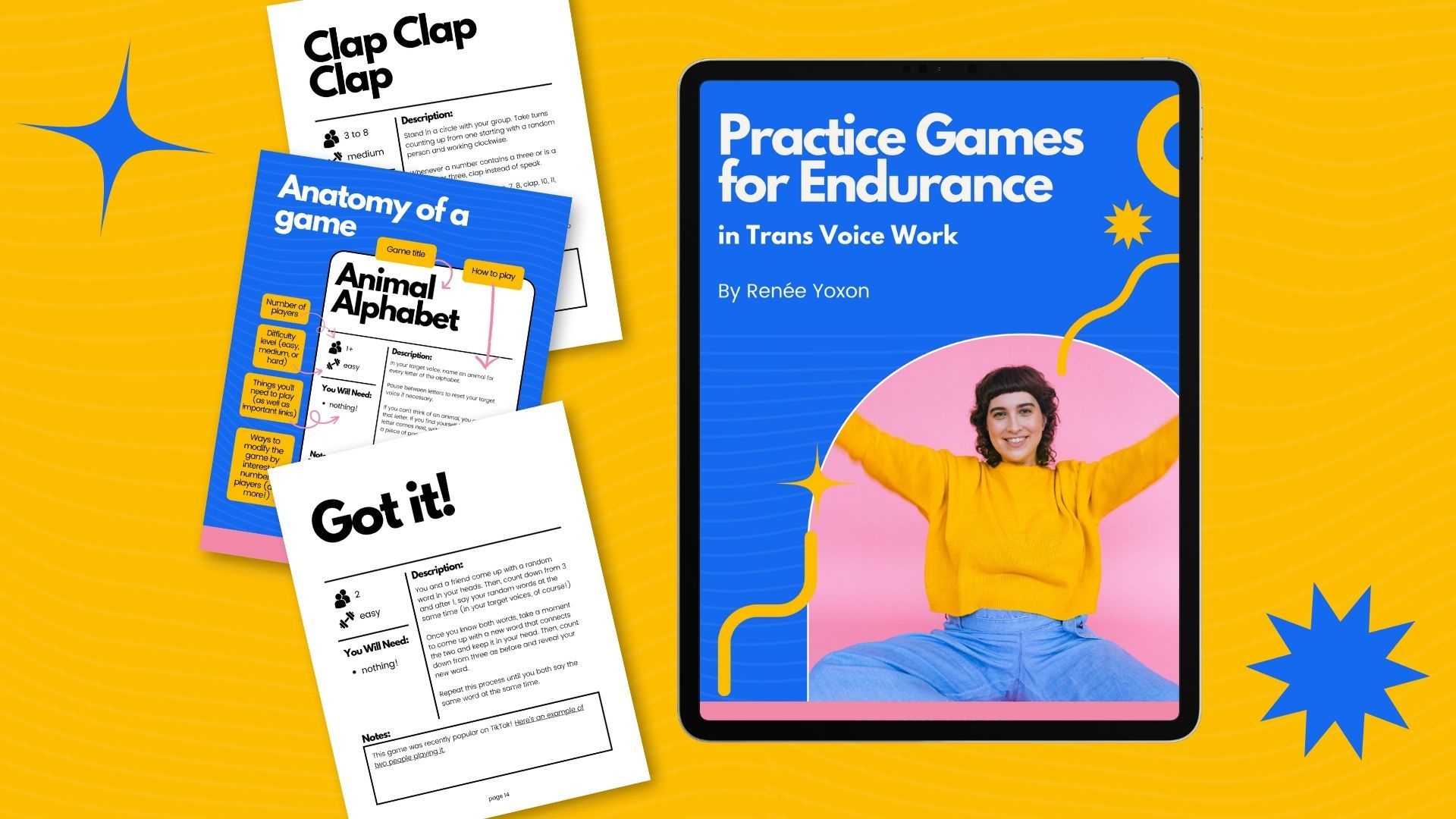
Grab the free ebook.Practice Games for Endurance is full of exercises exactly like these. You can find it and other free resources in the freebies library.
Practice Games for Endurance
This workbook will teach you easy games that will help you maintain your target voice for longer.
If you want a step-by-step framework for the underlying voice work, like resonance, pitch, weight, contour, all of it, my free one-hour webinar is the best place to start. Change the Gender of Your Voice: No Hormones or Surgery Required gives you the full foundation so that games like these actually have something to build on.
Keep Practicing in the Real World
The gap between "I can do it when I'm focused" and "I can do it in real life" is the most common challenge in trans voice training, and it's completely solvable.
The solution isn't more focused practice. It's a messier practice. Distracted practice. Practice that asks your voice to fend for itself while your brain is busy elsewhere.
That's what cognitive load training does. And games are one of the most enjoyable ways to get there.
Try these exercises a few times this week and see what shifts. Let me know in the comments on the video above: which game was hardest for you? And if you have a cognitive load game you already use, share it because I want to try it.
Ready to build the foundation underneath the games? Sign up for my free one-hour masterclass, Change the Gender of Your Voice: No Hormones or Surgery Required, and get a step-by-step framework for gender-affirming voice work from a trans voice coach who gets it.
Want weekly tips, resources, and insights on trans voice training? Sign up for my newsletter and get the latest content delivered straight to your inbox. It's free!
Want weekly tips, resources, and insights on trans voice training? Sign up for my newsletter and get the latest content delivered straight to your inbox. It's free!
This is a new magic button that tells Google to suggest this blog more often, including in the new AI Overviews. That way, quality trans voice information gets amplified, and we get found by the people who need it. It would mean a lot to me and help trans people everywhere if you click it.
Hi, I'm Renée! (they/them)
I'm a queer, nonbinary, and disabled singer, songwriter and gender-affirming voice teacher.
I've been a voice teacher since 2008, I have four full-length albums out, and I have degrees in physics, jazz, and songwriting.
I love creating, I love figuring things out, but most of all, I love helping people.
Want weekly tips, resources, and insights on trans voice training? Sign up for my newsletter and get the latest content delivered straight to your inbox. It's free!
I know you're here because you're striving to live your most authentic life, yet one major hurdle remains: your voice. Instead of empowering you, it brings dysphoria, misgendering, and discomfort.
So, are you ready to create a voice that resonates deeply and authentically with who you are? Join me for an empowering FREE webinar where you'll learn practical and easy skills that will show you how to create a voice that fills you with confidence and joy—without relying on medical interventions!