Can't Tell Pitch from Resonance? Try This Robot Voice Exercise
Jan 15, 2026
Have you been told a million times that "resonance is THE thing you need to master to change your voice," but when you try to practice it, you honestly can't tell if you're changing your resonance or just changing your pitch?
If your brain feels like it's short-circuiting every time you try to work on resonance, I have the perfect exercise for you. And yes, it involves talking like a robot.
As a gender-affirming voice teacher, I see this confusion all the time in trans voice training. Not being able to tell the difference between pitch and resonance is one of the most common stumbling blocks for anyone working on transgender voice training, whether you're pursuing voice feminization, masculinization, or designing a nonbinary voice.
But here's the good news: this confusion is completely normal, and today I'm going to show you exactly why it happens and how the Robot Voice Exercise can help you finally feel and hear the difference.
Watch the Full Video
Prefer to read? Keep scrolling for a complete breakdown of the Robot Voice Exercise, why it works, and how to use it in your voice training practice.
Why Pitch and Resonance Feel Impossible to Tell Apart
Let's start with the problem. You're trying to work on your resonance—making your voice sound brighter or darker—but every time you try, it just feels like you're going higher or lower in pitch. And you're not sure if you're doing it right.
Here's the thing: your ear naturally hears brightness as "high" and darkness as "low."
That's actually why resonance is so powerful for changing how people perceive your voice. Your brain automatically associates a bright sound with femininity and a dark sound with masculinity, even when the pitch hasn't changed at all.
But it's also what makes resonance so hard to practice in trans voice training, because your brain keeps telling you, "That sounds higher!" when actually, the pitch hasn't moved—the resonance has.

Your Resonance Breakthrough: Spectrogram Basics for Trans Voice Training
So how do we untangle these two things? Simple: instead of trying to level up your ears really quickly, we just need to remove some variables.
We need a way to lock in your pitch so that you know any changes you hear are coming from resonance, not from going up or down in your vocal range.
And that's where the Robot Voice Exercise comes in.
What Are Pitch and Resonance?
Before we dive into the exercise, let's quickly break down what pitch and resonance actually are. If you're already familiar with these concepts and want to jump straight to the exercise, feel free to skip ahead.
Understanding Pitch in Voice Training
Pitch is created by the vibration of your vocal folds. When you phonate (when you make sound) your vocal folds come together and vibrate at a certain speed. The faster they vibrate, the higher the pitch.
You can feel this vibration if you place your hand gently on your throat and say "ahhhh."
Pitch is measured in Hertz (Hz), and it's what you see when you use a tuner or a pitch tracking app. This is the characteristic most people think of first when they begin transgender voice training.

Gender-Affirming Voice 101: Pitch
Understanding Resonance in Trans Voice Training
Resonance, on the other hand, is controlled by the size and shape of your vocal tract—everything above your vocal folds, including your throat, mouth, and sometimes your nose.
Your vocal tract acts like a filter. It takes the sound produced by your vocal folds and colours it, making it sound brighter or darker.
- A smaller vocal tract creates a brighter sound.
- A larger vocal tract creates a darker sound.
The key thing to understand is this: you can change the resonance of your voice without changing the pitch at all.
It just doesn't seem like it because our ears naturally perceive brightness as "high" and darkness as "low." It feels like the pitch is changing, even when it's not.
That's the illusion we're about to break with this trans voice lesson.
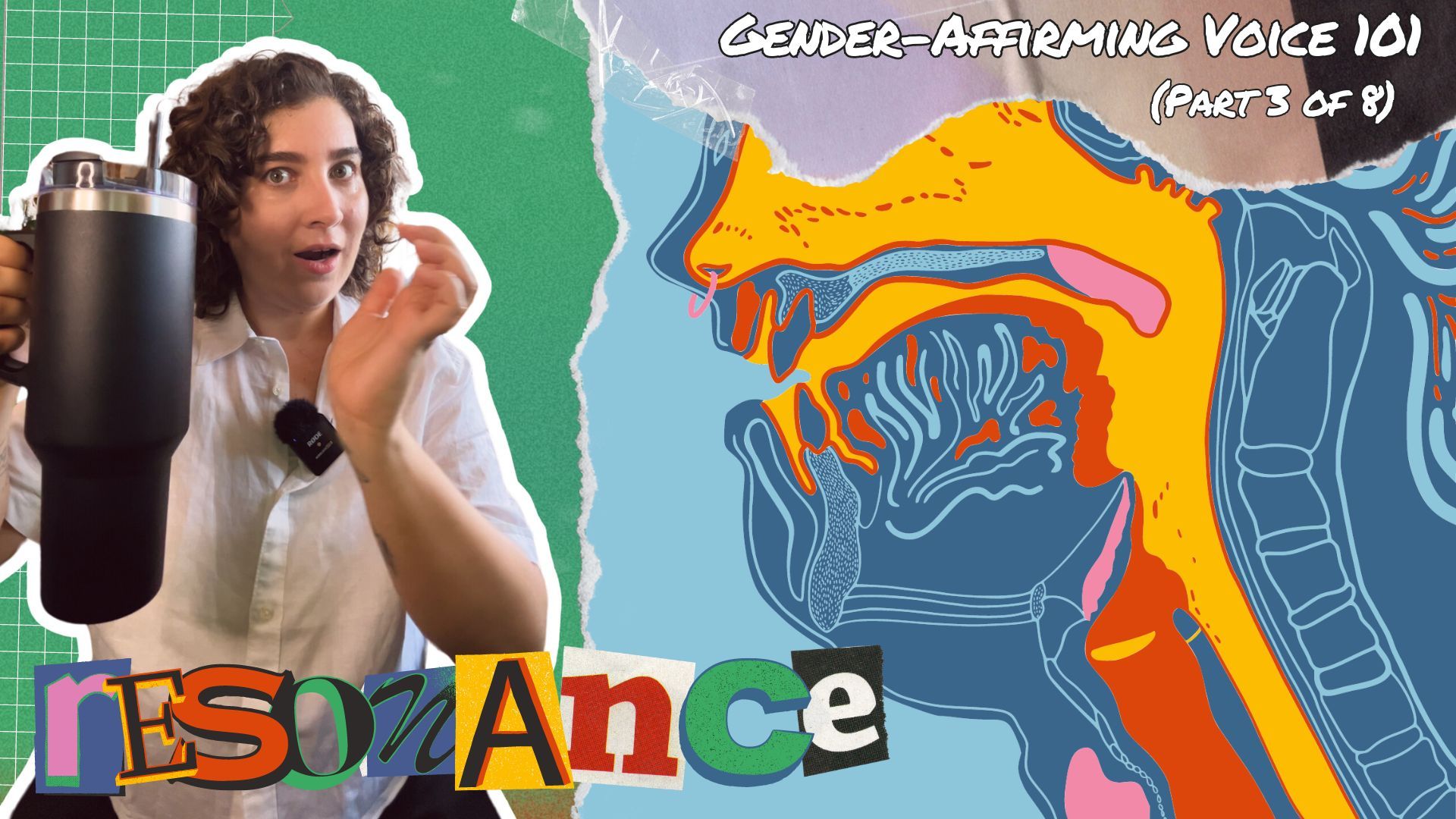
Gender-Affirming Voice 101: Resonance
The Robot Voice Exercise
Okay, here's the exercise. It's simple, but it's powerful for anyone working on voice training.
Step 1: Choose a Comfortable Pitch
Pick a note in the middle of your speaking range. It doesn't have to be perfect, just something that feels easy and neutral. Say "ahhhh" on that pitch.
Step 2: Lock In That Pitch
Now, speak an entire sentence on that same pitch. Like a robot. Monotone. No inflection, no ups and downs. Just one flat note.
If you have a tuner or a pitch tracking app, you can use it to make sure your pitch is staying stable. But honestly, you don't need one—just do your best to keep it flat.
Step 3: Change Your Resonance, Not Your Pitch
Now, while staying on that same monotone pitch, try making your voice sound darker or brighter by making the space in your mouth and throat bigger or smaller.
For a darker resonance: Imagine you're yawning while you speak. Let the back of your throat open up and visualize your voice coming from your chest. Let your voice sound big and boomy.
For a brighter resonance: Smile with your cheeks, not your mouth. Visualize that you're speaking from the front of your face instead of the back of your throat.
This is the core technique in gender-affirming voice training that helps you develop control over your vocal characteristics.
Step 4: Go Back and Forth
Where some people really feel the difference is in alternating between dark and bright while staying on that same robot pitch.
Try saying your sentence in dark resonance, then bright, then dark, then bright.
Notice how different they sound, even though the pitch hasn't changed at all? That's resonance.
Watch the video at the top of this blog post to see me go through these steps.
Common Pitfalls & Tips
Now that you've tried it, let's troubleshoot some common issues I see in my transgender vocal training practice.
1. "I can't stay on one pitch—it keeps sliding around."
That's okay! It takes practice. Start with just one or two words, like "hello" or "my name is," and gradually build up to longer sentences. You can also try speaking into a tuner to lock in the pitch and watch it while speaking to ensure that it doesn't change.
2. "It sounds robotic and weird."
Good! That's exactly what it's supposed to sound like. The whole point of this exercise is to remove the natural pitch variation of speech so you can isolate resonance.
It shows you how important both of these characteristics are to how your voice is perceived. So don't worry, this will not be your final vocal sound! Once you've practiced this way, you can add inflection back in later.
3. "I'm not sure if I'm actually changing my resonance."
If you're not sure, try exaggerating. Make the brightest, squeakiest sound you can. Then make the deepest, darkest sound you can. Then find the middle. Sometimes going to the extremes helps you feel the difference.
And if you still aren't sure what's happening, go to resonance extremes again, but right after, take a breath and follow it up with a quick pitch scale. Focus on the difference in how you're using your muscles.
Take note of which muscles are activating when you change pitch versus when you change resonance.
4. "This feels totally unnatural."
It should! You're not supposed to talk like a robot in real life. This is just a diagnostic tool to help you hear and feel the difference between pitch and resonance in your voice training.
Just like with physical exercises, you're choosing to restrict your "range of motion" in order to better target and feel something you're working on. Once you've got that awareness, you can bring it into your natural speech.
Variations & Next Steps
Once you've got the basic Robot Voice Exercise down, here are some ways to level it up in your voice training practice:
1. Try It with Different Vowels
Different vowels naturally have different resonances, so experiment. Try "ee," "eh," "ah," "oh," and "oo" all on the same robot pitch, and notice how the resonance shifts even though the pitch stays the same.
2. Try It at Different Pitches
Practice the robot voice at a higher pitch, then at a lower pitch. This will help you learn that resonance is separate from pitch—you can have bright resonance at a low pitch, or dark resonance at a high pitch.
3. Add It to Your Warm-Up
Spend 30 seconds doing robot voice practice before you move into other exercises. It's a great way to check in with your resonance and make sure you're actually shifting it, not just sliding your pitch around.
4. Use It as a Reset Tool
If you're in the middle of practicing and you feel lost or confused, go back to robot voice. It's like a palate cleanser for your ears during voice training.
5. Add Inflection Back In
Once you've mastered maintaining a specific resonance on a stable pitch, try varying the pitch like you would naturally in speech and see if you can maintain your desired resonance.
Key Takeaways About Pitch and Resonance
1. The Confusion Is Normal
Your brain naturally hears brightness as "high" and darkness as "low," which makes it incredibly difficult to separate pitch from resonance when you're first learning. This isn't a failure on your part—it's just how human perception works.
2. Resonance Is Separate from Pitch
You can change your resonance without changing your pitch, and vice versa. They're independent characteristics that you can learn to control separately with practice.
3. Robot Voice Removes Variables
By locking in your pitch with monotone speech, you eliminate one variable and make it much easier to hear and feel changes in resonance. This diagnostic tool is invaluable for developing awareness.
4. Practice Builds Awareness
The more you practice isolating these characteristics, the easier it becomes to control them independently in your natural speech. Start with extremes, then find your comfortable middle ground.
Free Resources for Trans Voice Training
If you want to dive deeper into resonance work, check out my Resonance playlist on YouTube. It's full of exercises, explanations, and troubleshooting tips specifically designed for transgender voice training.
You can also explore my freebies library for additional voice training resources.
And if you're looking for a comprehensive approach to transforming your voice, my courses cover everything you need to develop a voice that feels authentically you, including detailed lessons on both pitch and resonance control. Check them out below.

Mindful Voice Feminization

Mix & Match! Designing Your Nonbinary Voice

Masculinize Your Voice Without Testosterone
Conclusion: Finding Your Voice Through Practice
The Robot Voice Exercise is a simple tool, but it's one of the best ways to finally feel the difference between pitch and resonance in your own voice. By removing the variable of pitch variation, you give yourself permission to focus entirely on resonance—and that focused attention is what builds real skill.
Remember: not every exercise works for every person, and that's okay. The more tools you have in your voice training toolkit, the easier it becomes to find what works for you and your unique voice.
This exercise might feel strange at first. It might feel robotic and unnatural. But that strangeness is actually the point—it's giving you a new lens through which to experience your own voice, and that fresh perspective is what allows real change to happen.
Whether you're just starting your journey with trans voice lessons or you've been working on your voice for years, this exercise can help you develop the kind of fine-tuned control that makes the difference between a voice that feels forced and a voice that feels like home.
Ready to take your voice training to the next level?
Join my free one-hour masterclass, Change the Gender of Your Voice: No Hormones or Surgeries Required, and discover the step-by-step path to transforming your voice with a transgender voice coach who understands your journey.
Want weekly tips, resources, and insights on trans voice training? Sign up for my newsletter and get the latest content delivered straight to your inbox. It's free!