The Truth About Vocal Fry (And What It Means for Trans Voice Training)
Jul 09, 2026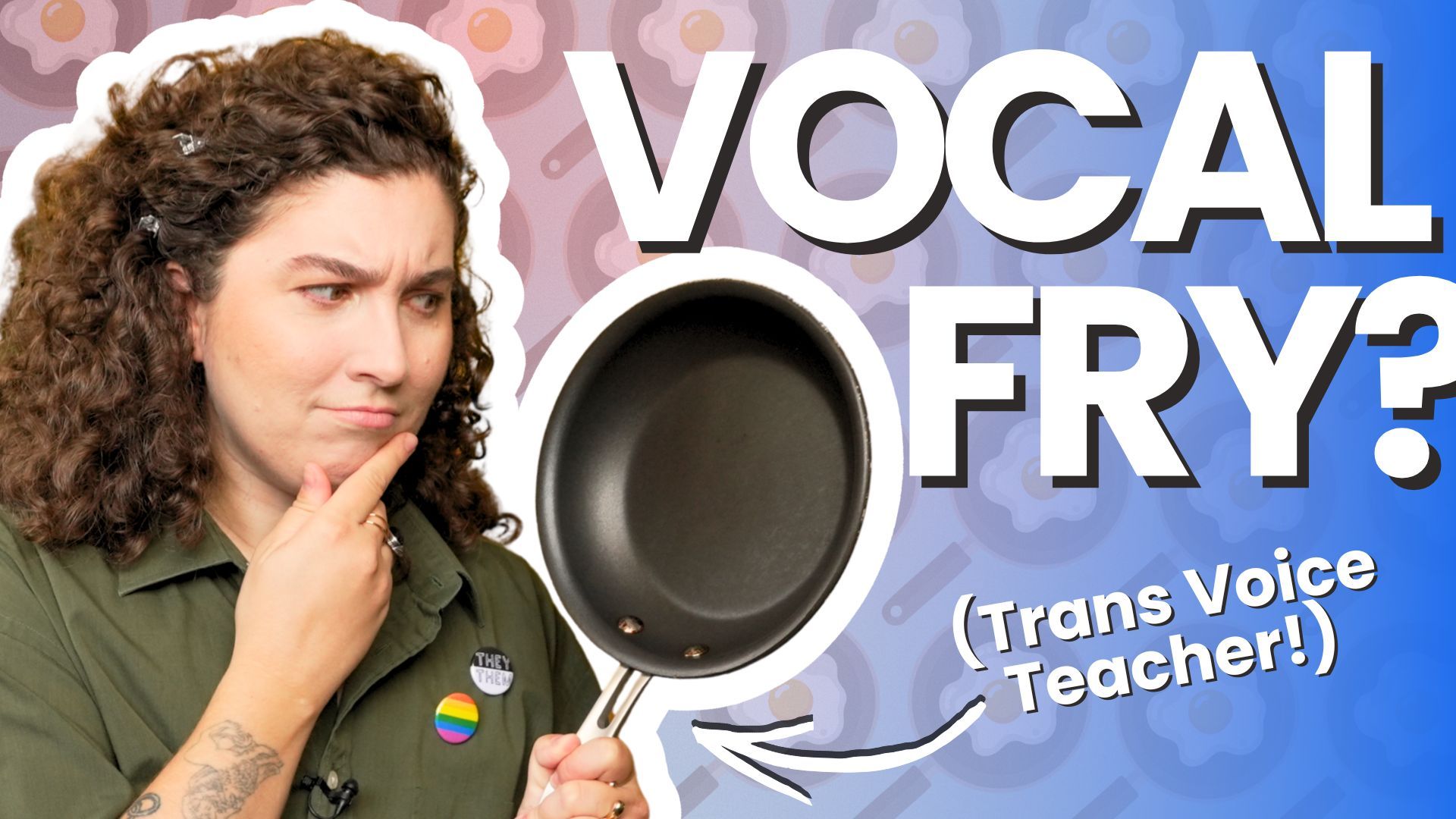
Vocal fry is one of the most talked-about vocal qualities of the last decade and a half. Some people want it. Some people hate it. Some people have been told it's ruining their careers.
As a gender-affirming voice teacher, I've watched this conversation swirl around my students for years, and I think a lot of what gets said about vocal fry is wrong, or at best incomplete. It also turns out to have some really interesting implications for trans voice training specifically.
So today, we're sorting through all of it: what vocal fry actually is, where the cultural baggage around it comes from (and why that baggage has a misogyny problem), what brand new research says that flips the whole narrative on its head, and what all of this means for your voice practice.
Watch the Full Video
Prefer to read? Keep scrolling for the full breakdown of vocal fry, the research, and what it means for your trans voice practice.
What Is Vocal Fry?
Vocal fry is the lowest of the four vocal registers. (I cover all four registers in my video Why Your Voice "Flips" (and How to Control It) which is worth a watch if that's new to you.)
The easiest way to understand what vocal fry sounds like is to hear it (which you can do in the video above), but here's how to understand what's happening physically. Vocal fry occurs when you bring the vocal folds together gently and completely, then allow only the tiniest trickle of air to bubble through. The result is that slow, crackling, popping sound.
A useful way to find it: prepare to cough, gently. You'll feel a complete closure in your airway. Now, instead of actually coughing, just maintain that closure and let as little air through as possible. That bubbling, crackling quality? That's vocal fry.
Think of it a bit like a lip trill, but at the level of your vocal folds. With a lip trill, you press your lips together and let air through at the same time. Vocal fry works the same way, just deeper in the vocal tract.
You've probably noticed that vocal fry tends to happen naturally at the ends of sentences, when your air supply is running low, and your pitch drops to its lowest point. Vocal fry thrives at the bottom of your pitch range, where there isn't much air pressure pushing through.
The Cultural Moment (And the Misogyny Problem)
In 2011, a study out of Long Island University found that more than two-thirds of the 34 college-age women they recorded used vocal fry, mostly at the ends of sentences.1 It wasn't a large sample, but the fallout was enormous.
A journalist for Science Magazine wrote about the study, it went viral, and according to Ira Glass, it became the most-read article ever published on the Science Magazine website in its 15-year history.2 The Today Show, Gawker, Huffington Post, Boing Boing—suddenly, vocal fry was everywhere, and it was framed as a problem. Specifically, a young women problem.
In 2014, a study told young American women outright that they should avoid vocal fry to maximize their career opportunities.3 The research found that voices exhibiting vocal fry were rated as less competent, less educated, less trustworthy, less attractive, and less hireable, and that those negative perceptions were even stronger when the listener was also a woman.
Here's what's worth sitting with, though: Ira Glass uses vocal fry. He always has. Nobody was writing furious emails about his voice. As linguist Penny Eckert pointed out, young men use vocal fry too! They also use upspeak, the word "like," and every other speech pattern that gets policed in women's voices. We just don't seem to notice or care as much when they do.2
I'll say it plainly: the cultural hatred of vocal fry in young women is rooted in misogyny. It's the latest in a long line of reasons to tell women that the way they naturally speak is wrong. That context matters enormously for trans people who are navigating voice training because you deserve to make choices about your voice based on what you want, not on a bias that was manufactured against women's speech.
Busting the Myth: What New Research Says
In 2025, linguist Jeanne Brown and her colleague Morgan Sonderegger at McGill University published a study in the Journal of Phonetics that looked at the actual acoustic correlates of vocal fry in 49 Canadian English-French bilingual speakers.4
What they found completely flips the script.
Acoustically, men's voices are unequivocally creakier than women's. Every single acoustic measure pointed in the same direction. And on top of that, vocal fry actually increased with age, meaning older speakers used more of it than younger ones.
So not only is vocal fry not a young women thing, it's actually more of an older men thing.
But if that's true, why do we hear it so much in women's voices? Brown addressed this at the 2026 meeting of the Acoustical Society of America, where she presented a follow-up perception study. She had 40 listeners rate the creakiness of voice recordings where the speaker's gender was ambiguous.5
When listeners couldn't tell if they were listening to a man or a woman, they were perfectly accurate at identifying vocal fry. But in everyday life, where we can see and make assumptions about who is speaking, we flag women as creaky far more often than the acoustic data justifies. We're not hearing more fry in women's voices because it's actually there. We're hearing it because we expect it to be there.
Brown put it this way: the conflict between those acoustic findings and everyday perception, in which women are routinely flagged as creakier, suggests the bias is real but socially constructed rather than grounded in how women actually sound. And then she said something that I think every trans person doing voice work deserves to hear: advice telling women to avoid vocal fry puts the burden on speakers rather than challenging listeners' biases, and that framing does real harm.
Vocal Fry and Trans Voice Training
Now that we've established that vocal fry is a natural feature of human speech that has been unfairly policed in women's voices, what does this mean for your trans voice practice? The implications go in a few different directions depending on your goals.
For Transfeminine Folks
Here's something interesting: even though the research shows men are actually creakier than women, the perception that vocal fry is feminine is very much alive in the cultural imagination. Think of the sultry, breathy, creaky voices we associate with femininity in film, television, and pop culture.
That means that if you're working on voice feminization, vocal fry could actually be a useful tool for signalling femininity, depending on your context and community. I want to be clear: you absolutely do not need vocal fry to be read as feminine. Resonance, pitch, and vocal weight do plenty of heavy lifting in that department. But if a little fry feels like part of your flavour of femininity, the research gives you permission to lean into it without shame.
If a sultry, breathy quality is one of your voice goals, I also have a dedicated video on creating a sultry, feminine voice that goes deeper on this.
For Transmasculine Folks
Vocal fry lives at the bottom of your pitch range, which means it can give the impression of a deeper, heavier voice. And some transmasculine folks do use it intentionally for exactly that reason.
I want to offer a gentle note of caution, though. In my experience, resonance is a far more powerful and reliable tool for projecting masculinity than vocal fry. A darker, larger resonance will usually do more for your goals than adding fry, and it typically allows you to speak at a fuller volume than vocal fry allows.
That said, if you want to experiment with vocal fry as one colour in your transmasculine palette, go for it — the research confirms it's very common in men's voices. You can explore all of this in depth in Masculinize Your Voice Without Testosterone.
For Nonbinary Folks
If you're designing a voice that doesn't map onto either end of the gender spectrum, or that plays with both, vocal fry is a genuinely versatile texture. Like any vocal colour, it's yours to use or set aside depending on what feels right for the voice you're building. My course Mix & Match: Designing Your Nonbinary Voice is all about exactly this kind of intentional voice design.
Not sure where to start? My free one-hour masterclass, Change the Gender of Your Voice, is a great introduction to how all these vocal qualities work together—and it's free.
Vocal Fry as a Therapeutic Tool
Here's something that might surprise you: regardless of whether you ever use vocal fry as a stylistic choice, it may still be a useful tool in your voice practice.
Speech-language pathologist Katarina H. makes the case on her YouTube channel that vocal fry, far from being something to eliminate, is one of the most useful therapeutic tools available for people dealing with vocal strain and tension. And she's far from the only SLP using it this way.
Here's why it works. When your voice is strained, it usually means too many muscles are working too hard during phonation.Vocal fry requires the opposite of all of that. The vocal folds come together in a gentle, relaxed way, with almost no air pressure pushing through. It's basically the most relaxed sound you can make.
This makes vocal fry genuinely useful for two things in particular:
- Releasing tension from a strained or tired voice. After a long day of voice practice or a demanding social situation, a few minutes of gentle vocal fry can help decompress the voice and release built-up muscular tension.
- Improving vocal fold closure for voices with unwanted breathiness. Vocal fry teaches the folds to come together without squeezing or pushing, which can help build healthier closure over time.
One important caveat: there's a healthy way to do vocal fry and a less healthy way. The key is to keep it gentle and relaxed, use very little air, and not push. If your vocal fry feels effortful or tense, that's a sign you're working too hard. Back off, let a little more air escape, and try again. Limit this practice to just a few minutes a day at first, to avoid overworking your voice.
Key Takeaways
1. Vocal Fry Is a Natural Feature of Human Speech
It is not a flaw, a bad habit, or an epidemic spreading through young women's speech. All human voices are capable of producing it, and the data shows it's actually more common in men and older speakers.
2. The Cultural Narrative Got It Almost Entirely Backwards
The perception that vocal fry is a young women's speech pattern is socially constructed, not acoustically accurate. The bias is real, but it says more about the listener than the speaker. You don't have to reshape your voice around someone else's bias.
3. It Can Be a Tool for Femininity, Masculinity, or Neither
In trans voice training, vocal fry is one colour on your palette. It can be used to signal femininity in cultural contexts where that perception is alive. It can add texture to a transmasculine voice. Or it can simply be a therapeutic aid you use after practice. You get to decide whether it belongs in your voice.
4. Used Gently, It Can Help a Tired Voice Recover
If you've been pushing your voice hard during practice, a few minutes of relaxed vocal fry can help release tension and reset, as long as you keep it easy and pressure-free.
Free Resources
If this post got you curious about exploring your voice more intentionally, here are some places to go next:
- My freebies library — including the voice mixing board tool, which is a great way to map out the specific qualities you're drawn to
- How to Create a Sultry Feminine Voice — a dedicated deep-dive on that breathy, creaky quality
- Why Your Voice "Flips" (and How to Control It) — my video on vocal registers
- The Ultimate Guide to Trans Voice Training — a full introduction to every vocal quality we work with in trans voice training
What Are Vocal Registers? Chest Voice vs Head Voice in Trans Voice Training

How to Create a SULTRY Feminine Voice

The Ultimate Guide to Trans Voice Training
References
- Abdelli-Beruh, N. B., Wolk, L., & Slavin, D. (2014). Prevalence of glottal fry in the speech of American English female college students. Journal of Voice, 28(2), 241.e1–241.e9. ↩
- Glass, I. (Host). (2015, January 23). If you don't have anything nice to say, SAY IT IN ALL CAPS (Act Two). This American Life. thisamericanlife.org ↩
- Anderson, R. C., Klofstad, C. A., Mayew, W. J., & Venkatachalam, M. (2014). Vocal fry may undermine the success of young women in the labor market. PLoS ONE, 9(5), e97506. doi.org/10.1371/journal.pone.0097506 ↩
- Brown, J., & Sonderegger, M. (2025). Acoustic correlates of vocal fry in Canadian English-French bilinguals. Journal of Phonetics. sciencedirect.com ↩
- Brown, J. (2026). Challenging biases about vocal fry. Presented at the 190th Meeting of the Acoustical Society of America. acoustics.org ↩
Want to explore your voice with guidance that actually gets your experience? Sign up for my free one-hour masterclass, Change the Gender of Your Voice: No Hormones or Surgeries Required, and start building the voice that feels like you.
Want weekly tips, resources, and insights on trans voice training? Sign up for my newsletter and get the latest content delivered straight to your inbox. It's free!