Speaking Freely with Floralis: Transfeminist Music, Mutual Aid, and Reclaiming Your Voice
Jul 02, 2026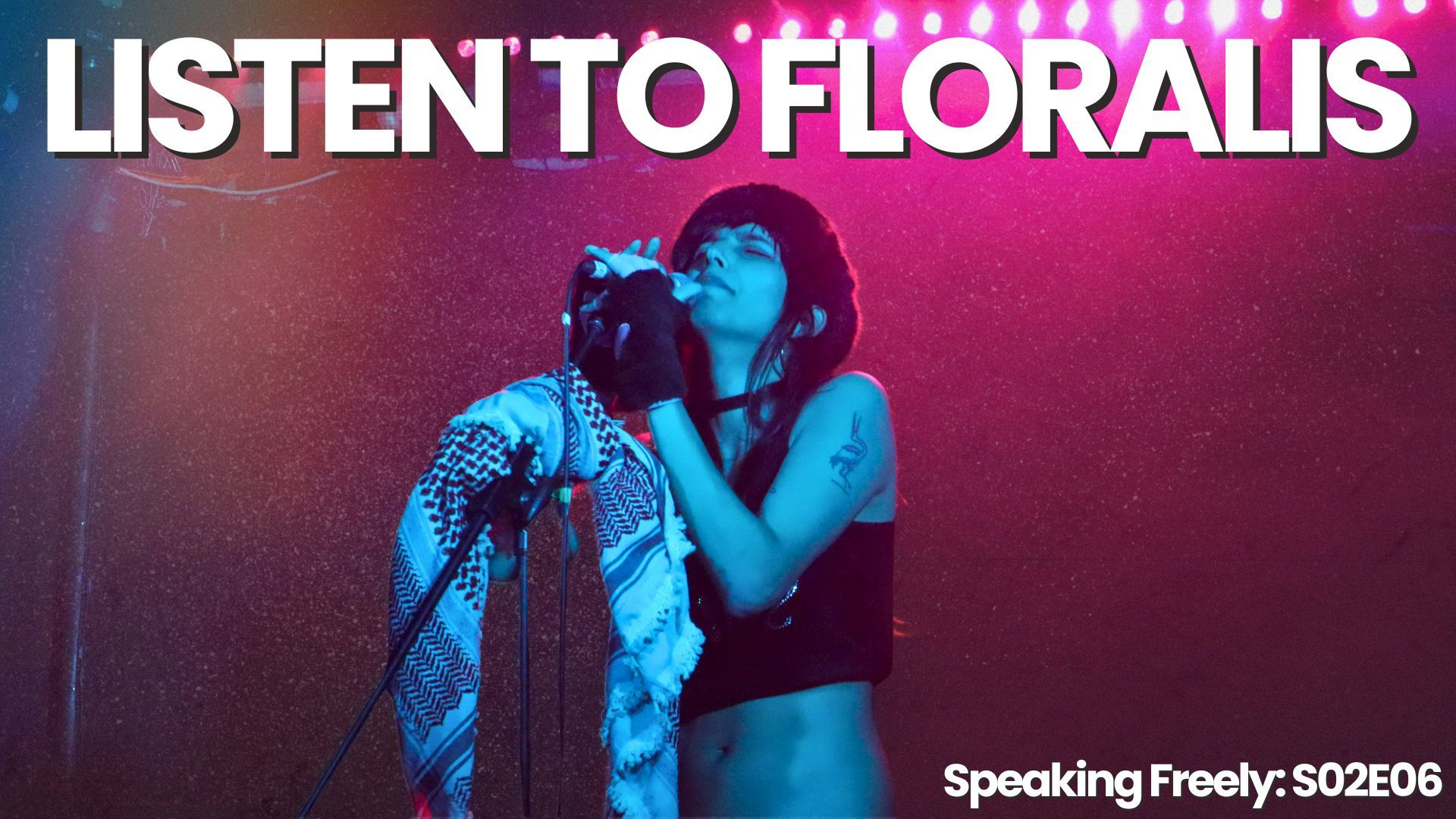
I met Floralis after she sent me a completely unsolicited email, and I am so glad she did. I've been following her on Instagram ever since, loving every bit of what she's building.
Floralis is a transfeminist, anti-imperialist musician and community organizer based in Brighton, UK. She makes electronic music rooted in punk, emo, and metal, blending in samples from Trinidadian and South Asian musical traditions to create something completely her own.
In this conversation, we talk about her music, what it means to make political art as a trans woman of colour, the hotel industrial complex, how she organizes through mutual aid and affinity groups, the UK Directory of Performers of Colour she built from scratch, and a conversation about her own voice that I think a lot of you will feel deeply seen by.
Table of Contents
- Watch the Full Video
- Meet Floralis
- Boycotting Spotify: A Matter of Principle
- Music Rooted in Heritage
- The Hotel Industrial Complex
- You Don't Need a Big Group to Make a Difference
- Building the UK Directory of Performers of Colour
- KVLL COLONISERS: A Gig Night With Teeth
- Black Cat Fest 2026
- Floralis on Her Own Voice
- Supporting Trans Refugees in the UK
- Where to Find Floralis
- Want More Speaking Freely?
Watch the Full Video
Prefer to read? Keep scrolling for the full conversation.
Meet Floralis
Floralis's debut album, My Name Is Floralis, toured with every date as a fundraiser for local anarchist direct action groups. Her sophomore album, Saboteur Club Anthems Vol. 1, is a specifically political club record, the kind of thing that makes you want to dance and organize at the same time.
She told me she originally found her footing in post-hardcore, with roots in punk, emo, and metal, before moving into electronic music. Her influences range from Björk to Danny Brown and Outkast, and that range shows up in the record. She describes it as her attempt to connect with her heritage, to encourage people to think about the violence of the hotel industry, to highlight the violence committed against transmisogyny-affected people, and, above everything, to inspire mobilization.
Boycotting Spotify: A Matter of Principle
Floralis pulled her music from Spotify, and the timing could not have been worse for her career. Her song "I Might Tell Your Mates" had just taken off on German anti-fascist playlists, becoming her biggest song to date, right as she was about to head out on a European tour built around that exact audience.
The decision came down to one thing: Spotify CEO Daniel Ek became chairman of Helsing, an AI military tech company, and invested $700 million into it. For Floralis, that was the moment Spotify stopped being a platform she could justify supporting.
"Look, Floralis, you have to stick to your principles," she told herself. "The principles are the only thing that really matters. And if you are choosing to sell out your principles, then what's the point in your music?"
She and other artists launched a Boycott Spotify campaign together, though the account was quickly reported and taken down. Her music now lives on Bandcamp. She cites artists like Godspeed You! Black Emperor and Chumbawamba, whose histories of sticking to their politics even at real career cost, as a major influence on how she wants to be remembered.
Music Rooted in Heritage
Floralis' family is mixed Scottish and Indo-Trinidadian. Trinidad, she explained, is roughly 40 percent Indian and 40 percent West African by population, a legacy of indentured labour and slavery under colonial rule.
Her earlier punk and electronic music didn't have explicit ties to that heritage, so she started weaving in field recordings and samples from Trinidadian and Indian music, building something that sounded authentically her own rather than just an emo kid or a metalhead with a drum machine. You can hear that blend clearly in tracks like "I Might Tell Your Mate" and "Hotel Industrial Complex."
The Hotel Industrial Complex
One of the album's centrepiece tracks takes its name from something Floralis is passionate about: the way the hotel industry functions as a modern continuation of colonial control across the Caribbean and the Global South.
She described how, in many Caribbean nations, the hotel industry effectively replaced the sugarcane plantations as the primary mechanism for foreign powers to maintain a presence, keeping seawater and running water clean for tourists while local communities go without, and steering visitors away from local neighbourhoods under the guise of safety.
The song closes with a clip from someone in the Israeli tourism industry, discussing tourism policy in ways Floralis sees as a stark illustration of the same underlying dynamic: tourism functioning as a tool of settler colonialism and ongoing state control, whether the setting is the Caribbean or occupied Palestine.
You Don't Need a Big Group to Make a Difference
A recurring theme in our conversation was how people can find their place in activism without needing to join a major organization. Floralis is an outspoken advocate for affinity groups and mutual aid networks. These are the small, local, person-to-person kind of organizing that doesn't require permission or connections to start.
She shared a story about a friend, a cis man who runs a film night, who wanted to help but didn't know how. She pointed him to a local trans mutual aid group and suggested he donate the proceeds from his next event to them. It raised a thousand pounds. I shared a small story of my own too: a single Facebook group post-it note in my building's laundry room has turned into an ongoing tenant network that helps neighbours push back against rent hikes every year.
Her core belief is straightforward: everyone has something to offer the fight, whether that's making social media graphics, cooking, or organizing a blockade with friends. As she put it, "if I can help one person, one person's life is massive."
Building the UK Directory of Performers of Colour
Floralis started the UK Directory of Performers of Colour after repeatedly being turned away from shows by promoters who told her, bluntly, "We don't book artists like you." She noticed lineups would mix a dream pop band, a hardcore band, and a metal band without a second thought, but electronic music and hip hop rarely made the cut. As she put it, that divide is rooted in the legacy of segregation, not in any real musical incompatibility.
Her own break came when a friend, a white performer named Liv Wynter, refused to play an all-white lineup in Brighton and specifically requested Floralis be booked instead. That one act of solidarity opened doors, and Floralis has spent years since trying to open them for other artists of colour, starting with a directory just for Brighton and eventually expanding it UK-wide so other performers could add themselves.
Now, the shows she puts on aim for at least 50 percent people of colour on the lineup, a deliberate, practical target designed to shift what Brighton audiences see as normal on a DIY bill.
KVLL COLONISERS: A Gig Night With Teeth
Floralis also runs a gig night called KVLL COLONISERS, a name that is exactly as provocative as it sounds. The shows are often scheduled to land on the anniversary of a famous colonizer's death, past lineups have marked the deaths of figures like Henry Kissinger.
The lineups are majority people of colour, alongside white DIY artists who, as Floralis put it, have "got good values." The goal is the same one behind her Directory work: normalize mixed bills so audiences stop treating genre and race as the same dividing line. She described the first KVLL COLONISERS show as a genuinely beautiful mixture, a room full of punks watching a Kashmiri hip hop group called Smoked Poets, cheering them on from the crowd. It's the kind of night that chips away at social isolation for everyone in the room, performers and audience alike.
Black Cat Fest 2026
KVLL COLONISERS eventually grew into something bigger: Black Cat Fest, an all-day, multi-venue antifascist, anti-imperialist trans liberation festival happening July 3rd, 2026, by the seafront in Brighton. It's proudly presented by KVLL COLONISERS, Transcend Borders, and Death Before Detransition, a collective known for all-trans lineups blending queercore and hardcore.
The festival spans talks, live music, and stalls across multiple venues, with sets from princess xixi, Reptile B, piglet, Misgendered, Liv Wynter, htmljones, Leibniz, Floralis, Subira, Dust [UK], Kapil Seshasayee, LVZ Silenciosa, [Brick], Ayu Mesi, Could Be Ghosts, Sunday Best, Splitting Gums, Clouded, and Not Richard & Her Majesty.
Twenty-five percent of the festival's profits go directly to trans refugees and asylum seekers, through Transcend Borders, an organization Floralis co-founded. Follow along on Black Cat Fest's Instagram.
Floralis on Her Own Voice
As a gender-affirming voice teacher, this part of the conversation meant a lot to me. I asked Floralis about her relationship with her own voice as a trans woman and a transmisogyny-affected person, and whether intentional voice work, singing or otherwise, has been part of her journey.
She was candid that she can access a higher, "girlier" register (you can hear it at the start of "Black Combat Boots," which people sometimes assume is pitch-shifted, but isn't), but that mostly, she simply likes the way her voice sounds. What struck me most was what she said next, about the pressure trans women face specifically around this choice:
"There tends to be a weird thing that people kind of say to trans women that voice train, where they kind of act as if people are being sellouts for voice training. And it's like, oh, you hate yourself, you've internalized too much of the self-hate. And it's disproportionately applied towards trans women. A lot of people are doing it for survival, or they feel dysphoric, and if they want to have their voice that way, then they should have their voice that way. Simultaneously, if you don't want your voice trained, then you shouldn't have to. It's all about the ability to choose whatever you want to do."
She also spoke about how comments on her voice not being "feminine enough" have made her self-conscious at times, even though, without that pressure, she genuinely loves having a deep voice. I couldn't agree more with her framing here: voice training should be a personal decision rooted in your own happiness and safety, not an external mandate in either direction, whether that pressure comes from people telling you to train or telling you not to.
She shared a moment after a London show that stuck with her, a young brown transfemme who told her, in tears, how meaningful it was to see another brown trans woman on stage with a deep voice, and to feel like she didn't have to change that about herself. If any part of this conversation resonates with your own relationship to your voice, I'd love for you to explore what feels right for you, whether that's through a course like my Mindful Voice Feminization program or simply giving yourself permission to love the voice you already have.
Supporting Trans Refugees in the UK
Every episode of Speaking Freely closes with space for my guest to speak freely about whatever matters most to them, and Floralis used hers to talk about the needs of trans refugees and asylum seekers in the UK.
She walked me through the UK's "Hostile Environment" policy, introduced in 2012, which restricts undocumented people's access to banking, housing, and healthcare, and funnels immigration data from the NHS to the Home Office for use in deportations. In 2025 alone, 60,000 people were deported from the UK. Trans refugees and asylum seekers face a particular intersection of harm: there's no policy to help them access hormones, many are forced to detransition, and the Home Office regularly misgenders people while housing them in unsafe, deteriorating accommodations.
Language barriers and unconscious racism within predominantly white queer communities can also cut trans people of colour off from the informal fundraising networks, like GoFundMe campaigns among friends, that many trans people rely on to access gender-affirming care.
This is the reason Floralis co-founded Transcend Borders, which distributes 500-pound grants directly to trans refugees and asylum seekers, and why she's stepping back into an active role with the organization after a period away.
Where to Find Floralis
Floralis's music isn't on Spotify, but you can find Saboteur Club Anthems Volume One and her full catalogue on Bandcamp. Follow her on Instagram @floralis_lc for updates on new music and shows, and keep an eye on Black Cat Fest's Instagram for festival details.
Want More Speaking Freely?
If you loved this conversation, you can find more interviews just like it on the Speaking Freely playlist. A few of my favourite episodes are linked below.
Trans People Are Older Than Rome | Sophie Edwards on Speaking Freely

Trans Icon, Transit Icon: Bernie Wagenblast | Speaking Freely

How a Trans Woman Found Her Voice (and Became a Voice Actress)
Want weekly tips, resources, and insights on trans voice training? Sign up for my newsletter and get the latest content delivered straight to your inbox. It's free!