Are Voicemaxxers Accidentally Right About Masculine Voice Training? A Trans Voice Teacher + SLP React
Jun 19, 2026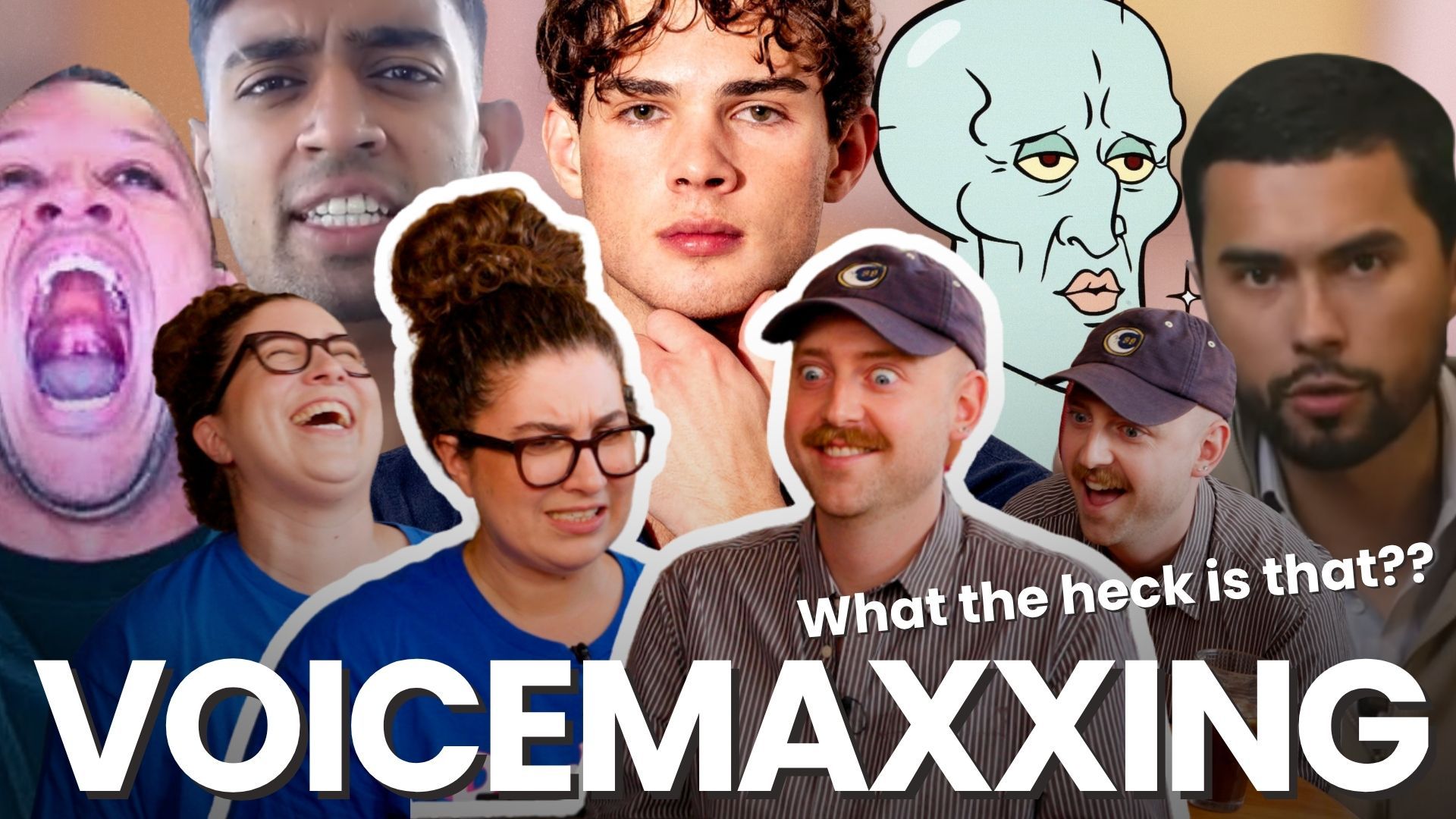
It seems like every video on YouTube right now is about looksmaxxing, AI, or GLP-1s. And then I learned about voicemaxxing and so now I'm making it your problem too.
I'm Renée, a gender-affirming voice teacher, and I invited my friend and colleague Rory Jack (he/they), a speech-language pathologist and gender-affirming voice care provider, to sit down with me and react to some voicemaxxing content curated by the brilliant Nora Mahon (she/her) of the Vocal Congruence Project.
The question we kept coming back to: Is there any actual merit to what voicemaxxers are doing? Are they accidentally onto something useful for people interested in deepening and masculinizing their voice? Or is it bro-science all the way down?
Read on, or scroll straight to the video to find out what we discovered.

🎉 Join Out Loud 2026, Free 30-Day Trans Voice Challenge!
Throughout June, I'm running a free Pride voice training challenge. Sign up at reneeyoxon.com/outloud2026. And if you're ready to go deeper, all three of my courses are 33% off with code OUTLOUD33 until the end of the month. Grab your course here.
Watch the Full Video
Prefer to read? Keep scrolling for a full breakdown of what we watched, what we found, and what it might actually mean for masculine voice training.
What Is Voicemaxxing?
You may have heard of looksmaxxing—the online "self-improvement" trend (and I'm using that term very loosely) originally coined on incel forums and later popularised on TikTok. It's focused on maximizing physical attractiveness, ranging from fairly benign practices like skincare and gym routines to more extreme interventions.
Voicemaxxing is exactly what it sounds like: a subset of looksmaxxing focused specifically on the voice. It's primarily targeted at cisgender men who want to sound deeper, more authoritative, and (in their words) more masculine.
I was introduced to it by the incredibly brilliant Nora Mahon during a training she gave through the Vocal Congruence Project, an incredible resource for gender-affirming voice work that I highly recommend checking out. Nora also appeared on this channel to talk about how to find a trans voice coach or SLP. I recommend checking that interview out!
How to Choose the Right Trans Voice Care Provider (Advice from Nora Mahon)
Voicemaxxing vs. Gender-Affirming Voice Care
I want to be careful here, because I don't think looksmaxxing and gender-affirming care are the same thing. They are fundamentally different in purpose and philosophy.
Looksmaxxing tends to be rooted in the idea that physical attractiveness, as defined by a rigid, often racist and exclusionary set of standards, is the only thing that matters, sometimes even at the expense of your health. Gender-affirming care, by contrast, is about becoming more yourself. Voice care, specifically, is recognized as an essential component of gender-affirming healthcare for transgender, nonbinary, and gender-expansive people.
But here's what I find interesting. There is a Venn diagram of looksmaxxing and gender-affirming care, and inside it you'll find things like hormone replacement therapy, surgery, and voice training. The bodily autonomy that looksmaxxers take for granted is very often the same bodily autonomy that's actively denied to trans people. Make of that what you will.
Now, does voicemaxxing have any actual merit for people who want to masculinize their voice? That's the question Rory and I set out to answer.
The Videos We Watched
Nora put together a range of videos spanning the types of content someone is likely to encounter when searching for voice deepening advice on YouTube. We grouped them into four categories. I've included all the videos below, but please watch at your own risk/discretion! Your YouTube algorithm is at stake 😅
The Representative Ones
These are the videos that most accurately represent what voicemaxxing content looks like in the wild.
Video 1: "How to Voicemaxx to Get a Hot Voice"
This is the main video that situates voicemaxxing in the broader looksmaxxing framework. It runs through some classics, like neck strengthening, speaking in monotone, diaphragmatic breathing. As Nora noted, it has a lot of adjacent-to-correct ideas but never quite sticks the landing.
Our Reaction
Renée: Right away this video is already only talking about pitch, and I take issue with the way it ties your voice to professional success and physical appeal. That said, the diaphragmatic breathing section is fine, if vague. He doesn't really tell you how to do it, just that you should. And the straw technique is almost right, except he calls it "strengthening" your vocal cords, which... no.
Rory: The neck strengthening advice is the opposite of what you'd want. Voice training isn't about weak muscles. If that were the problem, we'd be in voice therapy territory, dealing with an underlying pathology. To deepen your resonance, you want to decrease tension, not build muscle. Stretching? Sure. Neck crunches? That's going the wrong direction entirely.
Video 2: "How to Have a Deeper Voice Naturally"
This one runs through the most common voicemaxxing exercises like diaphragmatic breathing, neck strengthening, monotone practice, and cites some research on voice and perceived attractiveness (which is NOT good research by the way, we looked it up.)
Our Reaction
Tea: I spent an embarrassing amount of time tracking down the study he cites about monotone voices and sexual attractiveness. The trail goes: Times of India, Daily Telegraph, a study published in a journal founded and run by proponents of conversion therapy for gay and trans people, with 35 women evaluating 178 men after being primed to associate dominance with attractiveness. Junk science, in other words. Also, he recommends drinking 3 to 4 litres of water a day, which is actually too much water.
Rory: No one is "self-discovery-maxxing" and they should be. These videos are so focused on prescriptive outcomes (96Hz is scientifically the most attractive pitch!) that there's no room for the messiness of actually figuring out what your voice wants to do. Also, dehydration does not shrink your vocal folds. Drinking water is great for vocal hygiene, but it cannot change the size or shape of your vocal folds. If it could, people would be doing a lot worse things than not drinking enough water.
The Ridiculous Ones
These are exactly what they sound like. No further explanation required, but we'll let our reactions do the talking.
Video 3: "How to Create a Deeper Voice"
A very classic masculinity-meets-alt-wellness creator. If you've spent any time in these corners of the internet, you'll recognize the vibe immediately. Nora flagged this one for the "ball breathing" segment starting around the 1:20 mark.
Our Reaction
Renée: So this creator believes his voice deepened because he broke up his "neurotic holding patterns" through bioenergetics. Which is... not nothing, actually? Releasing tension in the body can genuinely support a more resonant voice. But the way he gets there, breathing into your balls, the mysterious stool, the castration metaphors, makes it nearly impossible to extract what's actually useful. Also, he keeps telling you to just have a deeper voice without telling you how to get there, which is a great way to sell more content.
Rory: There's something almost somatic in what he's describing. The idea that psychological tension manifests in the body and affects the voice is not entirely wrong. But holding your mouth open to release throat tension would likely increase tension, not decrease it. And "breathing into your balls" as a cue is fine in theory (it's about relaxing your pelvic floor) but the framing makes it completely inaccessible to anyone who doesn't share his very particular worldview.
Video 4: "Get a Deep Voice — Affirmations"
We're just going to let this one speak for itself. Don't watch this one unless you want to get a masculine voice subliminally. (That was sarcasm.)
Our Reaction
Renée: Subliminal affirmations do not work. For anything. This video has nearly a million views. I don't have more to say about that, but Rory and I did briefly discuss quitting our jobs to record Montreal rainstorms and retire on the ad revenue.
Rory: This one does not require clinical commentary.
The Emotional Ones
These were the most unexpectedly moving videos in the bunch, as well as the ones that drew the most interesting parallels to gender incongruence and the emotional weight of feeling misaligned with your own voice.
Video 5: "How to Get a Deeper Voice"
The second half of this video pivots entirely to the creator's emotional relationship with his voice, like his distress at not feeling masculine enough and his sense of being a kind of father figure to his audience. The parallels to gender incongruence and the desire to feel at home in your own voice are hard to miss.
Our Reaction
Renée: I was not expecting to feel this much watching a voicemaxxing video. The way this creator talks about his voice, the distress, the feeling that he couldn't be taken seriously, the longing to sound more like himself, is genuinely moving, and not entirely different from what I hear from trans and transmasculine clients. The difference is what gets layered on top of that very real feeling: the misogyny, the parasocial "I am your father" posturing, the idea that a deeper voice is the only path to being a real man.
Rory: What he's describing, wanting to inhabit your own voice more fully, wanting to sound more like who you are, is legitimate. And there's room to acknowledge that without endorsing everything else in this video. What I can't get behind is the idea that content creators should position themselves as caregivers for their audience. That's not responsible, regardless of what kind of content you make.
The Good Ones
Yes, they exist. (Although spoiler alert: they are not really voicemaxxing videos.)
Video 6: "Making Your Voice Deeper — The Sound of Authority | Public Speaking"
This is the only video in Nora's sample made by someone with an actual voice background. The creator is a performer with a master's degree in vocal pedagogy. Unsurprisingly, it's the most grounded and technically sound of the bunch.
Our Reaction
Renée: Finally, someone with actual credentials! I love that this video is made by a woman, and I love that she leads with "forcing your voice too low can cause vocal fatigue and strain." The frog breath exercise she demonstrates is something I actually use with transmasculine clients: that silent gasp that drops the larynx immediately. Some nuance could be added, but there's nothing here that's outright wrong.
Rory: This is the only video in the whole batch where I didn't find myself wincing. Her cuing is clear, her approach is grounded, and she's not selling anyone a stool or a masculinity crisis. The note about not sustaining a lowered larynx all day is a good one, though I'd add that with practice, it becomes much less effortful than she implies.
So, Are They Accidentally Right?
I'll let you draw your own conclusions from what we just watched. What I will say is this: there are genuine kernels of useful information scattered through this content, but they're embedded in a lot of ideology, pseudoscience, and occasionally, ball breathing.
The emotional through-line is actually the most striking thing. The distress some of these creators describe, such as feeling like a stranger in your own voice, wanting to sound more like yourself, is something many trans and transmasculine people know intimately. The desire to masculinize your voice is valid and real, whether you're a cis man who grew up feeling like his voice wasn't quite right, or a trans man who wants his voice to reflect who he is.
The difference is in the approach: evidence-based voice training that's designed with you in mind versus bro-science built on rigid ideas about what a man's voice is supposed to sound like.
Evidence-Based Masculine Voice Training
If you're interested in deepening and masculinizing your voice in a way that's safe, evidence-based, and designed with you, as a transmasc person, in mind (i.e., not built on looksmaxxing ideology), that's exactly what my course Masculinize Your Voice Without Testosterone is for.
And if you want a taste of what working with a gender-affirming voice teacher actually looks like before committing to a course, my free one-hour masterclass Change the Gender of Your Voice: No Hormones or Surgery Required is a great place to start. I'll walk you through the core concepts of transgender voice training, including what actually works for masculinization, and you can decide from there where you want to go.
You can also keep exploring with my Masculinization playlist on YouTube, where I have a growing collection of exercises, explainers, and deep dives on everything from vocal weight to what actually happens to your voice on T.
Here are some of my favourite videos from the playlist:
Masculinize Your Voice Without Testosterone

Singing on Testosterone: What Trans Singers Need to Know (Interview with Eli Conley)
Why Your Voice Goes “Customer Service Mode” (And How to Stop It)
The Secret to Sounding Masculine AND Expressive (You Don't Have to Choose)
Thank you so much to Rory Jack for sharing their expertise and for not being too horrified by what we watched.
And a huge thank you to Nora Mahon and the Vocal Congruence Project for putting this content together and introducing me to this whole world. The VCP is a fantastic resource for gender-affirming voice, and I cannot recommend it enough.
🎉 Join Out Loud 2026, Free 30-Day Trans Voice Challenge!
Throughout June, I'm running a free Pride voice training challenge. Sign up at reneeyoxon.com/outloud2026. And if you're ready to go deeper, all three of my courses are 33% off with code OUTLOUD33 until the end of the month. Grab your course here.
Want weekly tips, resources, and insights on trans voice training? Sign up for my newsletter and get the latest content delivered straight to your inbox. It's free!