The Science of "Gay Voice" | Erin Broadhurst on Speaking Freely
Jun 11, 2026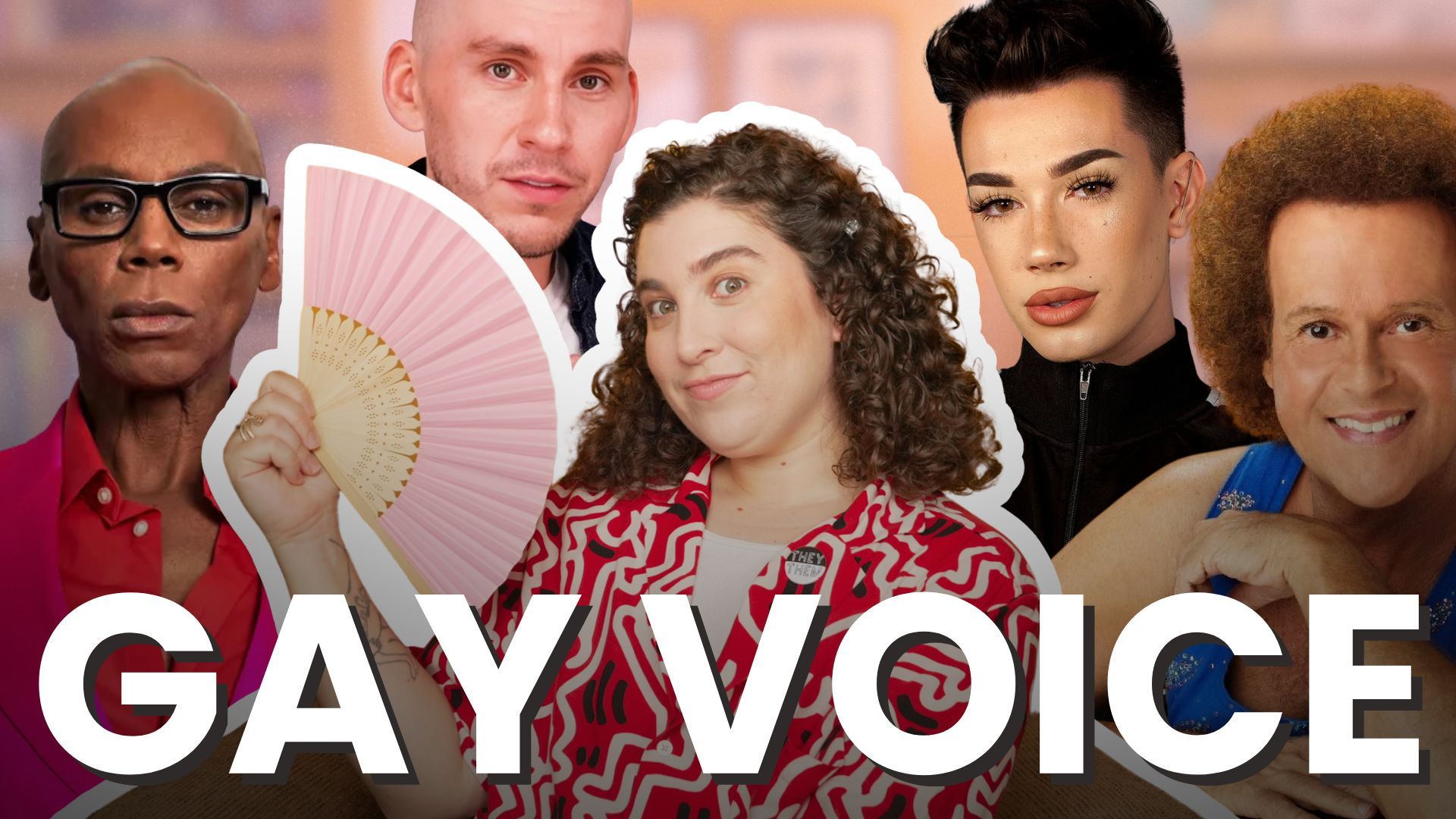
Have you ever heard someone speak and immediately thought, they sound gay... without being able to explain exactly why?
You're not imagining it. And you're not being reductive. You're picking up on something that linguists have been quietly investigating for decades. It's something real, complex, and far more interesting than any stereotype could capture.
In this episode of Speaking Freely, I'm joined by Erin Broadhurst, a linguistics and psychology graduate from the University of Oxford who went on to study forensic speech science at the University of York. Erin's undergraduate research into what we call "gay voice" went viral on Instagram, and that's how I found her. She asks exactly the questions that most people are too nervous to ask out loud, and she does it with genuine curiosity, ethical care, and a lot of fun.
Whether you're a trans or queer person who's ever thought about how your voice reads to others, or you're just fascinated by the way language carries identity, this conversation is for you.
🎉 June 2026 Pride Month offer
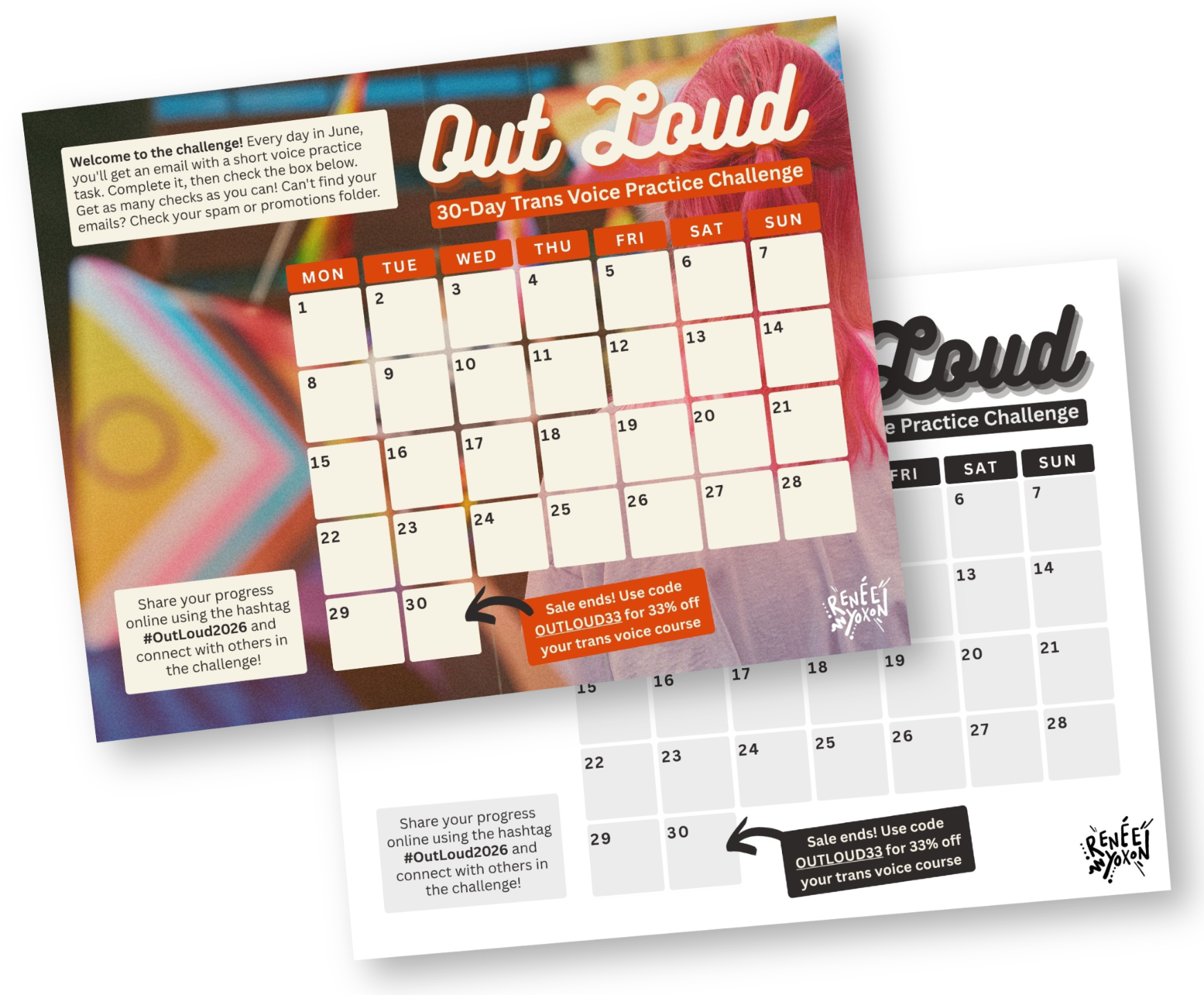
I'm running a free 30-day trans voice practice challenge called Out Loud! Sign up at reneeyoxon.com/outloud2026 to get your printable Out Loud calendar and daily practice challenge emails delivered every day throughout Pride Month.
And for the entire month of June, all three of my trans voice courses are 33% off using the code OUTLOUD33 at checkout. Grab your course here.
Table of Contents
- Watch the Full Video
- Meet Erin Broadhurst
- Is "Gay Voice" Actually a Thing?
- The "Gay Lisp" Is Not a Lisp
- It's Not About Pitch, It's About Contour
- Hyperarticulation and "Good Diction"
- Voice Onset Time: The Unexpected Finding
- Your Voice Changes Depending on Who You're Talking To
- Perception vs. Production: What the Research Really Shows
- What This Means if You're Working on Your Voice
- Speaking Freely: Erin's Closing Thoughts
- Find Erin Online
Watch the Full Video
Prefer to read? Keep scrolling for a full breakdown of what the research actually says about gay voice and what it means for anyone thinking about how their voice is perceived.
Meet Erin Broadhurst
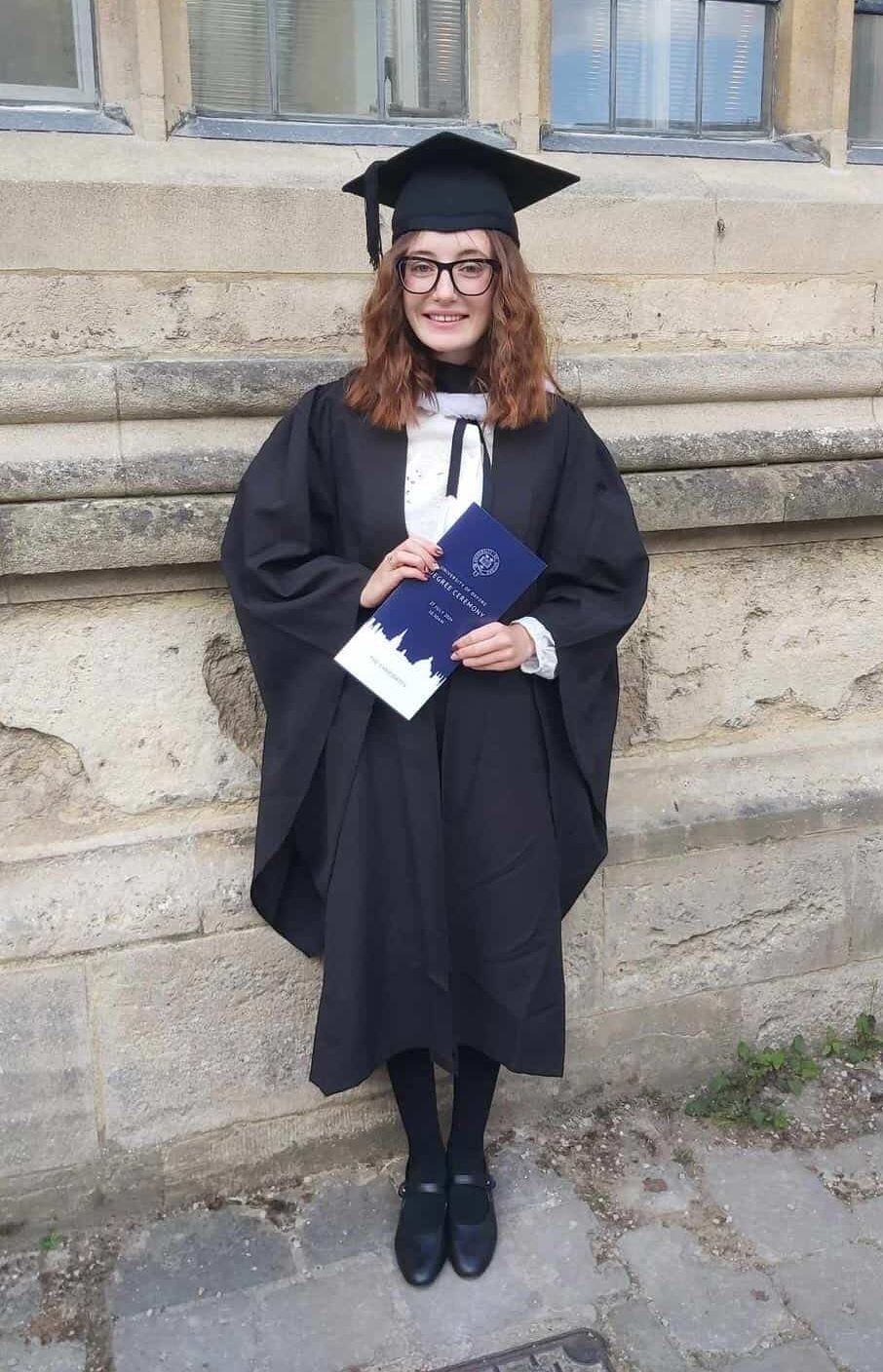
Erin Broadhurst graduated with a degree in psychology and linguistics from the University of Oxford, then completed a master's in forensic speech science at the University of York. She's currently applying for PhD funding to take her undergraduate research much further.
I first came across Erin through a viral Instagram reel about her undergraduate thesis, which is a study using identical twins (one gay, one straight) to investigate whether there are measurable acoustic differences in what we perceive as a "gay voice." The reel took off, and for good reason: Erin talks about a topic that most people sense is real but feel uncomfortable naming.
Importantly,Erin's not trying to out anyone or reduce queer identity to a set of vocal features. As she put it in our conversation, the best way to remove the stigma around something is to actually study it, openly and ethically.
Is "Gay Voice" Actually a Thing?
Erin's interest in this topic started with a YouTube Short of comedian Mateo Lane saying, "Everybody clap if you can hear my gay voice," and the whole audience clapping. She found herself wondering: how do we know? What are we actually picking up on?
She's bisexual herself, and within queer spaces she kept noticing that she could sometimes clock people without being able to articulate why. Rather than shying away from that observation, she decided to research it.
An important distinction Erin draws early on: there's a difference between how gay people actually speak and what gets perceived as gay even when the voice belongs to a straight person. Her undergraduate study was more of a production study (comparing how a gay twin and a straight twin actually spoke), but what she really wants to investigate, and plans to pursue in her PhD, is that perceptual dimension: what features trigger the perception of gayness in a listener's mind, regardless of the speaker's sexuality?
She compares it to the bisexual Doc Martens stereotype: not every bisexual person wears Doc Martens, and not everyone in Doc Martens is bisexual. But somewhere along the way, a small kernel of something became a signal that people within the community could intentionally use. Gay voice works similarly. It's not a reliable one-to-one mapping, but there's something real underneath the stereotype worth understanding.
The "Gay Lisp" Is Not a Lisp
This is one of my favourite parts of the conversation because Erin explains something that even many voice teachers get wrong.
A true lisp is a speech difference where the tongue jets between the teeth, producing a th-like sound instead of an s. What's colloquially called the "gay lisp" is something entirely different: it's called S fronting.
In standard English, the s sound is produced with the tip of your tongue touching the alveolar ridge (that hard bump just behind your upper front teeth). When the tongue moves even slightly forward toward the teeth, the sound shifts. It's not interdental (like a true lisp), but it creates a slightly different quality that, to many listeners, reads as lispier.
This finding comes from a 2014 study by Van Borsel et al., and it fits into a broader pattern Erin describes across the research: gay speech tends to be more peripheral. Vowels get pushed to the outer edges of the vocal space. Front vowels get more fronted, back vowels get more backed, and high vowels get higher. Everything moves toward extremes. S fronting is one piece of that larger picture.
This idea of peripherality is fascinating, and it connects to other features we'll get to in a moment.
It's Not About Pitch, It's About Contour
Here's something that surprises a lot of people, including many of my students who are working on voice feminization: gay men don't actually speak at a higher pitch on average.
Linville (1998) found no significant pitch difference in production. But Munson (2006) found that men with higher-pitched voices are rated as sounding gayer by listeners. It's a perceptual effect, not a production one.
What does show up in production is a wider pitch contour, i.e., more variation between the highs and lows within speech. Less monotone. More expressive range.
If you're a regular reader of this blog or viewer of my YouTube channel, you probably recognize this! I talk about contour as one of the five characteristics on my voice mixing board. And as Erin and I discussed, a wider contour is associated with both femininity and with gay male speech, which is not necessarily because gay men are "feminine," but because wide contour is fundamentally a sign of emotional expressiveness. In a society where men are conditioned to suppress their emotions, gay men may simply have more permission to express them, and that shows up in the voice.
As Erin put it: "Quick reminder that the patriarchy only managed to make men seem less emotional by rebranding anger as not an emotion." (Truly. This is the real talk we needed on this channel.)
If you want to understand contour and the other voice characteristics in depth, this video from my Gender-Affirming Voice 101 series is a great place to start.
Hyperarticulation and "Good Diction"
Erin went around asking friends what they thought made someone sound gay, and one answer kept coming up: really good diction.
That observation led her to the concept of hyperarticulation: the exaggeration of speech sounds, making phonetic features more distinct from each other. Think of it as pushing sounds further apart so they're less likely to blur together. It's the same mechanism behind vowel shifts in language change: when one sound drifts too close to another, the whole system adjusts to maintain contrast.
Hyperarticulation ties back to the peripherality pattern: everything pushed toward the edges, more distinct, more defined. And it connects to what a listener might describe as crisp diction, precision, or clarity.
This is what led Erin to her main acoustic measurement: voice onset time.
Voice Onset Time: The Unexpected Finding
Voice onset time (VOT) is the tiny gap between a consonant release and the beginning of voicing in the following vowel. Think of the difference between a t and a d: same place of articulation, but one is voiceless (t) and the other is voiced (d). After a voiceless consonant like t, there's a brief moment before your vocal folds start vibrating again and that's VOT.
A longer VOT sounds more aspirated, more forceful, more precise. Think of how Draco Malfoy says "Potter." That very airy, emphatic P. Or the difference between the k in Kate (long VOT, aspirated) versus the k in skate (short VOT, sounds more like a g without the s).
Erin's hypothesis was that the gay twin in her study would show longer VOT for word-initial t, consistent with hyperarticulation, making consonants more powerful and distinct.
She found the opposite! The straight twin showed longer VOT.
After working through the results, one possible explanation emerged: longer VOT is also associated with formality, professionalism, and careful speech, and the straight twin's conversations happened to be in a more formal, podcast-style context. So the difference may have been driven by context and register, not sexuality. Another great reminder that voice is always doing more than one thing at once.
Your Voice Changes Depending on Who You're Talking To
Erin also looked at whether the twins changed their speech depending on who they were talking to: gay-to-gay, straight-to-straight, and cross-sexuality conversations.
Her hypothesis was that the gay twin might capitalize on gay-sounding features when talking to another gay person like a kind of acoustic "hey, we've got something in common." But what she actually found was that both twins used shorter VOT when talking to the gay interlocutor, and longer VOT when talking to the straight one.
This points to general accommodation processes (the way we naturally shift our speech toward someone we want to connect with) rather than any deliberate sexuality signalling. Sexuality wasn't the main character driving the vocal differences. The desire for connection was.
I love this finding because it speaks directly to something I talk about with students all the time: your voice is already more flexible than you think. You don't speak to your boss the same way you speak to your dog. There's something in your most relaxed, playful, expressive voice (your "pet voice," your "best friend voice") that might be exactly what you're working toward in your voice training. You already have it. The work is learning to access it intentionally.
This is one of the reasons I created the freebies library, which is full of tools to help you start noticing and working with the voice you already have.
Perception vs. Production: What the Research Really Shows
One of the most important threads running through Erin's work is the distinction between what gay people actually do with their voices and what listeners perceive as gay.
Earlier research in this field often started by asking: What do women sound like? Then, do gay men do those things too? It's a (kind of, I guess lol) logical starting point, but it's also veeerry limiting. It reduces everything to a femininity framework, and it assumes the researcher already knows which variables matter.
Erin's proposed PhD approach flips this. She wants to use a tool developed by Montgomery and Moore, where listeners click whenever they hear something that makes them perceive a voice as gay. From those click patterns, researchers can identify what's actually happening in the audio at those moments rather than testing features selected in advance.
Even more fascinating: Montgomery and Moore found that listeners sometimes reported hearing features that weren't there. When a voice was primed as "rural," listeners claimed to hear rhoticity (the "r" in farm and brother) — even when the speaker wasn't rhotic at all. The expectation shaped the perception.
Erin wants to apply this to gay voice: if you prime listeners with words like "warm" or "expressive" or "masculine" before playing a clip, does that change what they think they hear? The stereotype might be shaping perception more than the acoustic reality. Which would tell us a lot about how identity is heard and how much of it lives in the listener's ear rather than the speaker's mouth.
What This Means if You're Working on Your Voice
I get questions from trans and queer people all the time about this. Some students want to minimize what they feel reads as gay in their voice. Others want to lean into it. Some trans women in the earlier stages of voice feminization worry that they "sound like a gay man," often because they've achieved some brightness in resonance and some pitch variation, but the overall quality still reads as masculine-gay rather than feminine.
What Erin's research confirms (and what I try to communicate in my teaching) is that there's no simple set of adjustments that will make a voice "sound gay" or "not sound gay." The perception is too context-dependent, too listener-dependent, and too tied up in expectation and stereotype to be that clean.
What is true is that voice is incredibly responsive to intention, context, and practice. The features associated with gay male speech (wide contour, peripheral articulation, expressiveness) overlap significantly with features we work on in voice feminization and nonbinary voice training. They're not the same thing, but they share roots in vocal expressiveness.
Speaking Freely: Erin's Closing Thoughts
At the end of every episode of Speaking Freely, I ask my guests to speak freely and say something they feel needs to be said, whether or not we've covered it.
Erin's answer was about curiosity. She talked about growing up as the first in her immediate family to attend university, the first from her school to go to Oxford, in a family of coal miners, carpenters, and NHS workers—people she deeply respects, but in an environment where intellectual curiosity wasn't always the most celebrated trait.
"If I can encourage anyone to just let your curiosity run free," she said. "If you wanna learn things, go learn them."
She also said something that I think applies as much to voice research as it does to life generally: the only way to move toward openness and transparency is to give well-meaning people the space to get things a little bit wrong, be willing to be corrected with grace, and learn from it.
That's the spirit I try to bring to this series, and I'm really grateful Erin brought it so fully to this conversation.
Find Erin Online
- TikTok: @stumbling.through.oxford
- Instagram: @stumbling.through.oxford
- Erin's undergraduate paper: Read the research →
Want More Interviews?
Explore more conversations like this one in the Speaking Freely playlist, where I talk with trans voice practitioners, researchers, educators, artists, and advocates from around the world. Or check out three of my favourites below:
When Testosterone Doesn't Change Your Voice: A Transmasculine Voice Journey | Rey Katz on Speaking Freelye

Singing on Testosterone: What Trans Singers Need to Know (Interview with Eli Conley)
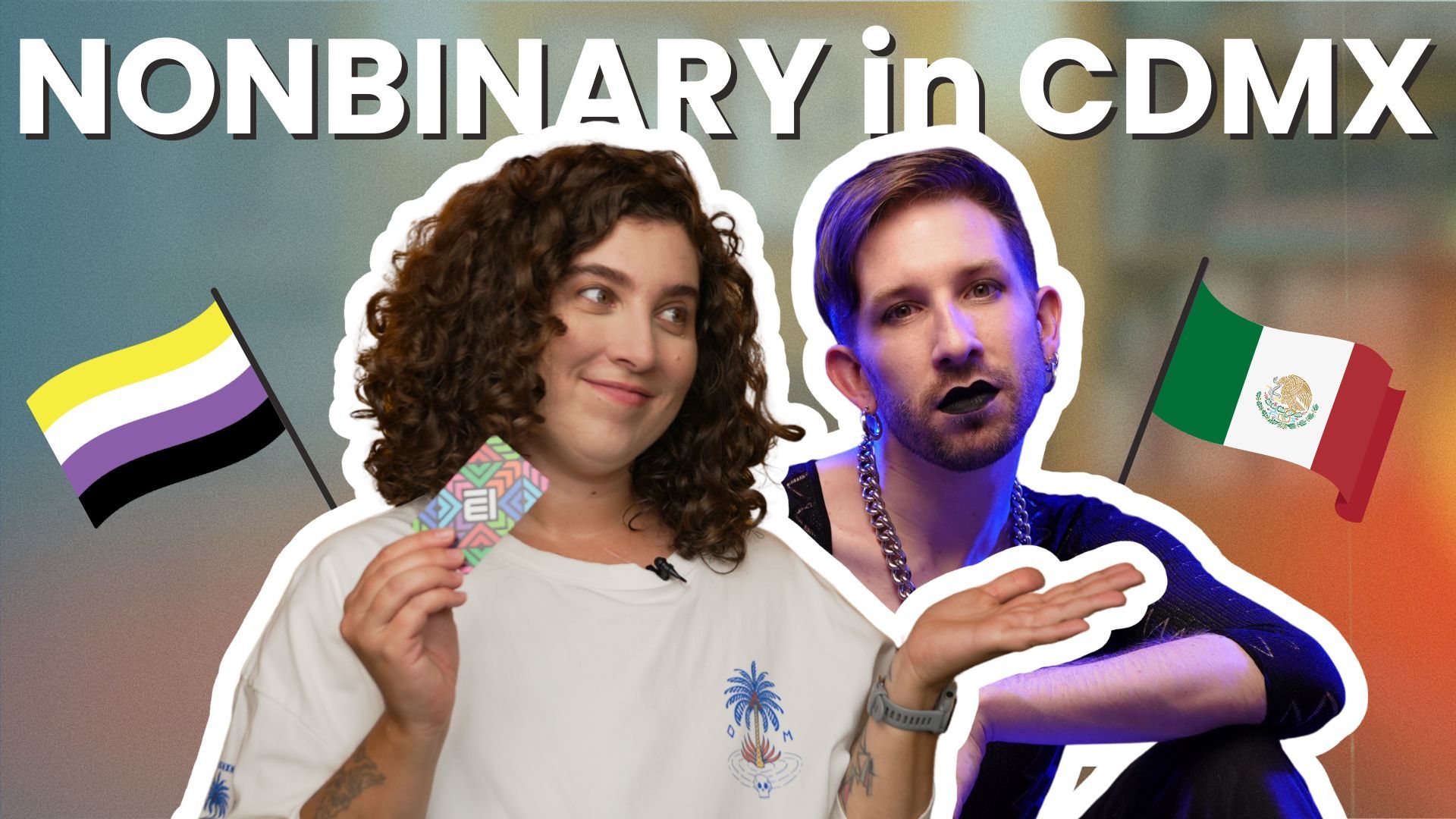
Nonbinary Voice, Gender, and Safety in Mexico City: A Conversation with Sergio Carazo Cardona
🎉 June 2026 Pride Month offer
I'm running a free 30-day trans voice practice challenge called Out Loud! Sign up at reneeyoxon.com/outloud2026 to get your printable Out Loud calendar and daily practice challenge emails delivered every day throughout Pride Month.
And for the entire month of June, all three of my trans voice courses are 33% off using the code OUTLOUD33 at checkout. Grab your course here.
Want weekly tips, resources, and insights on trans voice training? Sign up for my newsletter and get the latest content delivered straight to your inbox. It's free!