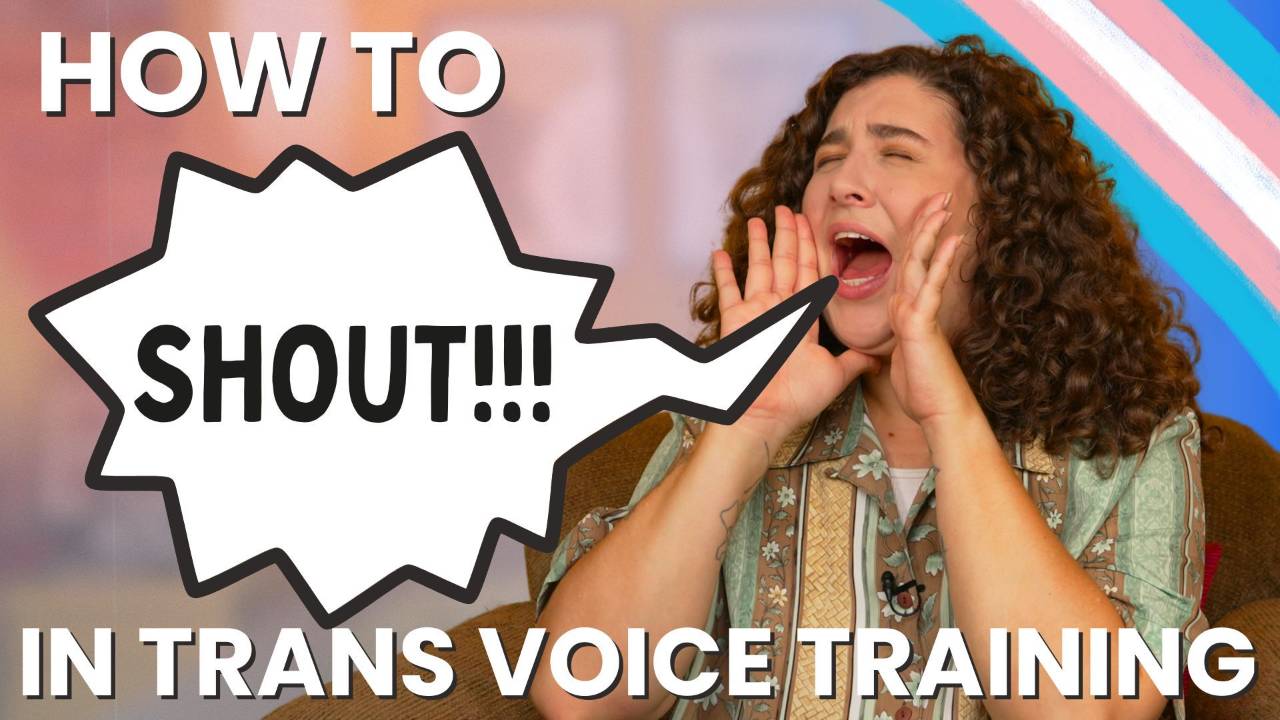
When it comes to shouting, some of us struggle and some of us find it comes easily. Throw gender-affirming voice work into the mix and things get complicated fast.
If you've been working on your trans voice training, you've probably learned some rules about vocal weight: light sounds feminine, heavy sounds masculine, that kind of thing. But as soon as you need to project your voice, those rules flip upside down. If you've ever shouted across a parking lot and heard all your hard work disappear, this is probably why.
In this post, I'll show you how to project your voice in a way that matches the voice you've been building, whatever that voice may be, and explain why the rules flip in the first place. The video below has every demo, so you can hear both shouts side by side.
Watch the Full Video
Watch the full video above. Prefer reading? Keep scrolling.
What Is Vocal Weight?
Vocal weight is the heaviness or lightness of a sound. You might also hear it called vocal fold mass, spectral tilt, or thick versus thin. I call it weight, and I describe it as heavy versus light.
Weight happens at the level of the vocal folds, the same place pitch happens, and a few things affect it:
How thick your vocal folds are at rest, which is mostly about what kind of puberty you've been through.
What pitch you're on, because higher notes stretch the folds and make them thinner, just like a stretched elastic band.
How hard you're pressing your vocal folds together during phonation (while you're making sound).
That last one is the part we can actually train, and these 3 simple vocal weight exercises are a good place to start. So when I talk about weight in this post, that's mostly what I mean: how much pressure the vocal folds come together with.
The Vocal Weight Spectrum
I like to think of vocal weight on a spectrum, like one slider on my mixing board. Very low pressure on one side creates a breathier sound, and high pressure on the other side creates a buzzy sound. In the middle of that spectrum is a balanced sound.
Think Marilyn Monroe or Keanu Reeves toward the breathy end, and Lori Petty or Eugene Levy toward the buzzy end (notice there's a woman and a man at each end). My own speaking voice tends to sit on the buzzier side of balanced.
Is Vocal Weight Gendered?
Since we're talking about gendered qualities, a quick disclaimer. Everyone's voice and gender journey is unique, and there is no one true masculinity or femininity. What follows is based on generalizations, and it isn't meant to perpetuate gender stereotypes. So if what I describe doesn't match your flavour of masculinity or femininity (or neither!), take what works and leave what doesn't. And tell me about it in the comments on the video, because those conversations make this field richer for everyone.
Vocal weight may not be as gendered a vocal characteristic as resonance or pitch, but there is a general tendency. Vocal folds that go through a testosterone-dominant puberty get thicker, and that creates a buzzier sound at an average speaking volume. So we tend to hear heavier as more masculine and lighter as more feminine.
But your mileage may vary. My voice is on the buzzy side, and I still get read as a woman a lot. If I take all the weight out, I get what I call my GPS voice: "Turn left here." You can hear it in the video.
How to Project Your Voice: Why Loudness Needs Weight
To get loud, your voice needs two things: more air, and something for that air to push against. That something is your vocal folds closing. So if you try to shout in a really light or breathy way, there's nothing for the air to push against, and the shout fizzles out.
Once your vocal folds are closing, there are two very different ways to get loud.
The boomy, relaxed shout uses an open throat and lots of air from your belly.
The twangy shout uses a little muscle at the top of your larynx called the aryepiglottic sphincter. Squeezing it narrows the space just above your vocal folds, so it's less air and more pressure.1
Voice scientist Ingo Titze's modelling backs up this pairing. An open throat works best with lighter fold closure and more airflow, and a narrow throat works best with firmer closure and more pressure.2 Both are efficient ways to get loud. They just come from opposite ends.
In the video, I do both shouts on the same pitch so you can hear the difference.
At louder volumes, the rules we learn about vocal weight flip. Compared with each other, the relaxed shout, the one we usually hear as masculine, is the lighter one. The twangy shout, the one we usually hear as feminine, has your vocal folds closing more firmly, which makes it the heavier one.
Research on twang backs this up: the vocal folds stay closed for more of each vibration than they do in an ordinary sound.3 So loud always needs more weight, and twang makes that weight work harder for you. The narrowed space above the folds helps them close, and it adds a bright ring around 3,000 Hz, close to where human hearing is most sensitive. That's why a twangy shout cuts through a noisy room without a huge amount of effort.1
Why So Many Students Get Stuck
This is why so many of my students get stuck. Trans women spend months making their voices lighter, then need to shout at their kid who's about to run into the road, and all of that lightness disappears. It comes up so often that one of the big clinical textbooks for speech-language pathologists has a whole section on it.4
A lot of transmasculine students have the opposite problem: when they get loud, their voice goes high and bright. And if you find your voice also gets quiet when you go low, the Volume Knob Exercise trains your low notes to carry.
Shouting is weird like that! So let's practice.
Practice Projecting Your Voice: Two Shouts, Side by Side
If you've read my posts on shouting, coughing, and laughing (there's a feminine one and a masculine one, and both are linked at the end of this section), these exercises will look familiar. This time, I'm putting them side by side.
The Twangy Shout
Find the muscle that creates twang. You can try a nerd voice, a robot, a witch's cackle, that playground "nya nya" taunt, a duck quack, or a meow.
Squeeze the muscle you just found in your throat.
Make a little sound with the squeeze in place. It'll sound like a strangled cat, but it shouldn't hurt.
Release the squeeze just enough for the air to escape, while keeping the pressure in your belly.
Then add short words: "Hey!" "Over here!" "Wait!"
Not sure whether you're doing twang or just sounding nasal? The Nasality Test is a quick way to figure that out.
The Boomy Shout
Relax your jaw, shoulders, and neck. Total fish face.
Breathe low into your belly, like you're inflating your butt like a beach ball.
Make a low, relaxed moan, like you have the flu.
Push your belly outwards quickly and add more air to the moan, keeping your throat relaxed. Go from "uh" to "hey!"
Go Back and Forth
Then go back and forth between the two so you can feel the difference in your body. If you can, record yourself saying "Hey!" both ways and listen back. You can hear me do both shouts, on the same pitch, in the video.
Want to go deeper on either shout? These posts cover each one on its own, including a gradual way to build from speaking volume up to a shout:
How to Shout, Cough, and Laugh with a Feminine Voice: A Guide for Trans Voice Training
How to Shout, Laugh, and Cough Like a Dude
How to SHOUT in a 🌸feminine🌸 way
Conclusion: How to Project Your Voice and Still Sound Like You
So if you need to raise your volume, you kind of have to forget about what you're doing at low volumes and develop a voice for high volumes that you like just as much. It gets easier the more you practice alternating between the two.
My book, The Trans Voice Practice Journal, comes out November 19th. It's packed with practice logs and tracking pages, and it's a great place to keep track of experiments like the ones in this post. You can pre-order it now with the code VOICE20 for 20% off, and if you pre-order, you also get 15% off any of my courses. Just email proof of purchase to [email protected].
Titze (2002). "Regulating Glottal Airflow in Phonation: Application of the Maximum Power Transfer Theorem to a Low Dimensional Phonation Model." Journal of the Acoustical Society of America, 111(1), 367-376. https://doi.org/10.1121/1.1417526
Want weekly tips, resources, and insights on trans voice training? Sign up for my newsletter and get the latest content delivered straight to your inbox. It's free!
Want weekly tips, resources, and insights on trans voice training? Sign up for my newsletter and get the latest content delivered straight to your inbox. It's free!
This is a new magic button that tells Google to suggest this blog more often, including in the new AI Overviews. That way, quality trans voice information gets amplified, and we get found by the people who need it. It would mean a lot to me and help trans people everywhere if you click it.
Hi, I'm Renée! (they/them)
I'm a queer, nonbinary, and disabled singer, songwriter and gender-affirming voice teacher.
I've been a voice teacher since 2008, I have four full-length albums out, and I have degrees in physics, jazz, and songwriting.
I love creating, I love figuring things out, but most of all, I love helping people.
Want weekly tips, resources, and insights on trans voice training? Sign up for my newsletter and get the latest content delivered straight to your inbox. It's free!
I know you're here because you're striving to live your most authentic life, yet one major hurdle remains: your voice. Instead of empowering you, it brings dysphoria, misgendering, and discomfort.
So, are you ready to create a voice that resonates deeply and authentically with who you are? Join me for an empowering FREE webinar where you'll learn practical and easy skills that will show you how to create a voice that fills you with confidence and joy—without relying on medical interventions!